Pages

Showing posts with label Healing. Show all posts

Thursday, August 6, 2015

Rachel Reed

Have you ever heard of Rachel Reed? She is so many things, such as midwife, university lecturer, Doctor of Philosophy, and the writer of the beautiful blog Midwife Thinking. She carries with her knowledge for women who want good birth experiences, and for those who have had bad ones, she can help bring healing. She is compassionate. 

I would here like to introduce you to her writings, because she has been such a solid voice for me in my travelings in and out of the world of labor and delivery. She is honest and forthright, and she is kind. She cares very much for mothers. I wish we were neighbors to be honest.

I hope you can glean as much from her as I have. If you already know of her, which of her blog posts have you loved best? It is difficult to say, but I think these two might be my favorite. (Each word there has a different link.)

Have a lovely night!

P.s. If you click on her 'about' tab, you will find her resume. It is beyond impressive!

Thursday, July 9, 2015

Talk to Me: PPD and D-MER

I mentioned in a previous post that I had experienced post part depression after my third son was born. I wanted to write a post about how I realized I was suffering from postpartum depression (PPD) and dysphoric milk ejection reflex (D-MER), and what I was able to do to climb out of the brackish pit.

I was sitting on my couch not long after baby 3 was born, he was snuggled in for a nurse. All of a sudden this wave of despair washed over me. Not just the "Oh, I'm sad right now." kind, but the "Why bother even trying to go on? Life is worse then it has ever been." And also thoughts like, "I seriously hate my husband. I cannot even understand why I married him." This would last for about 10 seconds, and then it would pass. After about two weeks of this, I noticed these deep troughs of feeling correlated with nursings, more specifically when my milk let down. I dreaded it. Not long after that I realized I had read about this phenomenon while randomly browsing for birth stories on the internet. I was suffering from moderate dysphoric milk ejection reflex, or D-MER. (They hyphenate it because the acronym "DMER" had already been taken...)

D-MER is not the same as PPD, although mothers can have both. Also, it is not psychological in nature. I'll repeat that: D-MER is not psychological in nature. It is an anomaly based on the chemistry of milk let down. The best science of our day says that when prolactin goes up (it does more than just make you make milk, but for our purposes think of it is the lactation hormone) dopamine levels plummet for just a few seconds. In mothers who are experiencing D-MER, for some reason they feel that dopamine plummet as a wave of depressive feelings ranging from mild sadness, to more severe suicidal thoughts. Often the anomaly just sort of fizzles out as the mother and baby continue on their nursing journey. For some mothers they need to cease nursing their baby, because the wild hormone fluctuations are too damaging. (Yet another reason to stave off judgment for the mothers who do not nurse their babies.)

My remedies: 

  1. I personally felt greatly relieved from merely remembering what I had read. It's always nice to know you're not going crazy. This epiphany didn't make the sinking despair go away, though, it simply buoyed me up for the times I would experience it. 
  2. I am not a doctor, but I will tell you that I was able to find some information during that time that linked poor dopamine responses to magnesium deficiencies. I am a big proponent of getting the things we need from our foods, but I am not above taking a well chosen supplement. They can be life saving at times. I started supplementing with magnesium and it helped. Magnesium is a tricky mineral to supplement, because it can cause loose stools, and yet it needs to be in the intestines long enough to be absorbed... Good news is, even though supplementing is tricky, it did help some. It did not completely fix the problem, but I did find marked improvement. And luckily for me, the problem resolved with time. My main man and I have nursed longer than any of my other babes. I'm so grateful to be able to do it.

That isn't where things ended, though. Shortly after realizing all that craziness, I found myself standing in my kitchen one day just staring out my back window worried. I was worried about just about anything that my mind could grab hold of, but usually wild imaginings of what people thought of things I had said, or the way I had done this or that. I was anxious, restless, and just sad. It hit me that day as I was staring out the window, I hadn't always felt like that. I hadn't always felt so perpetually sad, and tired all the time. I am an active woman, and I while I wanted to be active still, I just felt tired. I spent some time searching in my mind that day, wondering when I all of a sudden felt so sure anything that was bad that could possibly happen would... and it hit me like a lightning bolt, this was postpartum depression. I hadn't felt this way a few long weeks ago while I was pregnant; it had been a good pregnancy, though it was a surprise.

My remedies: 

  1. I remembered that day that I had read an article written by a homeopath on different remedies for anxiety and depression. (I know, am I not the biggest nerd the world has ever seen? I just read all these seemingly random articles, but they come in so handy. Maybe it's God...) I found the article, and tried the homeopathic remedy Ignatia Amara (I used 30C). I felt miraculous improvement with this remedy, within minutes of taking it. Our house is never without it now. I have since moved on to my constitutional remedy, Sepia.
  2. During this same time, I also remembered the billion times I had been told PPD is strongly correlated to low vitamin B-12 levels, so I went in search of a good supplement for that. I took methylcobalamin (B-12), but didn't see any results. I was so disappointed. But I began to wonder about other B vitamins as well. To make a long story short, there are many different B vitamins all lumped together in what is referred to as a complex. The whole B vitamin complex is interconnected, and work closely together. I found that by supplementing one of the B vitamins, a person can unwittingly drive down level of other members of the B complex, and most, if not all of them have psychological effects because of their physiologic effects on our beautiful bodies and brains. After doing a lot of research I was able to find the most amazing food based B complex supplement. Ever.

I want to stress that these did not completely get rid of all of my symptoms 100% the first time taking them. The homeopathic remedy was awesome for minute to minute help, those times when I could just feel the anxiety creeping in. It is my miracle for that time frame. The B complex helped me feel at least 80% better after a small amount of time. I can't really say how long it was, I just realized one day, I wasn't fretful anymore. The last 20% has come with time as I have continued with the B complex.

I know there are a lot of people who are totally skeptical of homeopathic remedies. I can't say that I blame them, but I am here to tell you all they do work. I'll write my next post about the actual science (it is there oh ye doubters). Edit: Here is that post now!

So let's talk about this ladies. Have you experienced PPD, or D-MER? What was your experience like? What did you find that helped you? Or have you not? Are you still suffering? Please talk to us here. We would love to listen. Sometimes a listening, and empathetic ear can do wonders.

If you are wondering, but not sure that you have depression, here is a wonderful post with a list of possible symptoms.

Tuesday, May 5, 2015

On Cholesterol

This will be my second venture back into the blogging world after a brief sabbatical. During the time I was gone I changed a lot of diapers, had another baby, and started a Master's program in Health and Nutrition Education. I thought I'd drop the schooling bit in now, because what I'm about to introduce to you may seem radical...

I had a friend ask me the other day which cholesterol was the good, and which was the bad. I was totally embarrassed to admit that I couldn't remember, and honestly, that I had never known. As I thought about that the rest of the day, I finally realized the reason my mind had never retained that information is because I don't believe there is good and bad cholesterol. I really love cholesterol, and so I thought I'd share my mental ramblings on this sadly misunderstood nutrient.

What is Cholesterol?

Cholesterol fits tidily into the fats and lipids category, and should be revered for its many functions in the human body. Both HDL (high density lipoprotein), and LDL (low density lipoprotein) perform vital functions in the human body, and deficiencies in either are catastrophic in nature. Cholesterol, in times past, was blamed for clogging arteries. I find it poor logic, though, to look at a wound, and blame what we find there for the presence of the wound. We don't blame blood for scratches and cuts. We don't blame bandaids for them either. What is it that causes cholesterol to get stuck in a person's arteries? There are several mechanisms in place, but the primary problems that cause blockages in arteries are in fact poor blood sugar metabolism, which cause inflammation i.e. over consumption of carbohydrates (this can include fruit for particularly sick people) and resultant damages on a cellular level. Google this, "cholesterol patches damaged arteries" -- it's not really a secret.

Further, check out all cholesterol does for you (other than patch damaged arteries):

  • All cell membranes in the human body are made sturdy by a combination of cholesterol and saturated fat. So that pretty much covers everything your body does. Let's end there... Just kidding, there's more.
  • All human sex hormones are a break down of cholesterol. (That link is a Chris Masterjohn link. If you don't know of him, he's a smarty.) A  cholesterol deficiency can lead to a deficiency in these, which would wreak havoc on more or less all of your systems -- because our bodies function as a whole organism. You cannot experience degradation in one system alone. To name just a few of your systems that would struggle due to imbalance in these hormones, though: reproductive system (duh), pulmonary system, cardiovascular system, adrenal system, and... more. 
  • Many other hormones are also made from cholesterol, such as cortisol, the stress hormone, and aldosterone, which regulates mineral absorption.
  • Cholesterol aids in the absorption of fat soluble vitamins K, D, E, and A. Your body can even make vitamin D out of cholesterol. It's kind of this everywhere fix-it guy.
  • Your body uses cholesterol to make bile. Bile is a green, viscous liquid made in the liver, which aids in the digestion of fat.
  • It also aids in the absorption of minerals.
  • For all the women reading this, morning sickness has been linked to a cholesterol deficiency, because it is linked to hormonal imbalances, bile production, and mineral absorption. (Magnesium is a big culprit here. Magnesium can also make you smell better when you sweat. That's fodder for a different post, though.)

Where do you get it? Where can you get it? Where should you get it?

Your body makes cholesterol in your skin in the same sort of fashion as it make vitamin D. Your body can also make cholesterol out of carbohydrates, in a similar fashion it can manufacture saturated fats from carbohydrates. Caution friends, this is far from ideal. In the absence of sun, and dietary cholesterol (or saturated fats, as it were) your body will crave carbs so that it can manufacture these other building blocks. This adds an extra step, and we know that the over consumption of carbohydrates: 1. depletes our bodies of minerals, 2. injures our bodies on both a large and small scale.

It is also important to note, the cholesterol made by your skin when exposed to the sun is in a different form than dietary cholesterol, (it is sulfated, or attached to a sulfur atom) and serves different functions in the human body than the dietary form. Dietary cholesterol is also important, because your body doesn't make the sort you get from foods. Your body, when exposed to optimal amounts of sun, will make about 98% of your cholesterol! That is amazing, and also scary considering how much time we all spend inside, and all of the things we have heard about sparing our skin sun exposure...

Just to make this slightly more controversial, cholesterol lowering drugs inhibit the human body from making cholesterol. That's right folks. Even though there is this, and this we are still giving statin drugs to the aging... even though low cholesterol is linked to double the mortality rate than high cholesterol. It is also linked to depression, suicidal thoughts, and violent behaviors.

The best dietary sources for cholesterol are:

  • Shrimp
  • Lobster
  • Eggs
  • Liver
  • Pork
  • Beef
  • Chicken, with the skin
  • Cheese
  • Full fat milk
  • Cream
  • Butter
  • Human milk ("The cholesterol in human milk supplies an infant with close to six times the amount most adults consume from their food." -- Mary Enig PhD, and world renowned lipids expert.)

So basically, google "high cholesterol foods", and eat those. Provided they are real, whole foods. Avoid snack foods like tater chips.

Interesting articles to read on the subject. Warning: sometimes Masterjohn can be a little dry...

Dr. Chris Masterjohn (Read this especially if you fear I'm leading you down the path of heart disease.)
Dr. Mary Enig on breastmilk composition.


Also:
Wikipedia: Cholesterol (I know guys, Wikipedia. It actually does have some good information these days.)

Thursday, April 16, 2015

How to be Gentle to a Postpartum Mother

A few years ago, our darling sister, Ariel, wrote a wonderful post about how to speak to a pregnant woman. I loved it, and thought I might write a post about how to speak to a postpartum woman. To preface this conversation, I should mention that this may seem like, "Wow, I've had a lot of really crummy conversation right after I've had each of my children. I want to tell you about each of them. In great detail." I haven't, for each of these unfortunate experiences, I've had probably a thousand good ones. But there has been a lingering bite to some of these, and I think it is something we would all, myself included, do well to consider for the future.

1. Don't assume a mother wants, or doesn't want company. Just ask.
Giving birth is such a personal thing, and affects every mother differently. For me, each postpartum experience has been vastly different. Sometimes I have craved company, others I have relished time alone. There is no shame in asking how the mother is feeling, and if she would like company. Postpartum is a terrible time to be burdened with company you don't have the energy for. Which leads me to my next point...

2. If you visit, don't overstay your welcome.
The day my second son was born, I was in the restroom when I heard a knock at the front door. It was a lovely neighbor bringing us a meal. It was beyond thoughtful! She then sat and chatted. And chatted. And chatted... I was hiding in the bathroom, because I had just birthed a 10 lb. bowling ball after a 9 hour labor, and didn't have the energy for guests. I finally came out and sat on the couch, and my neighbor continued to chat... I honestly don't remember the resolution to that visit, (did I mention I was tired?) all I know is that it made me cry. That is a rather grandiose example, though. There was that other time visited my friend whose baby was a month old, and time got away from me because our sons were playing so nicely together. And then my friend suddenly stood up inexplicably... oh wait, no. She was just trying to get the message to me that we should have left a while ago. (We had been there an hour.) Let's just all remember to make visits short, or again, find some way of asking what the mother needs.

3. Don't make commentary on the size of family she ought to have. Also, don't assume she is planning on a large, or small family
Does this make anyone immediately awkward? It does me. After my second son was born, a lovely lady brought us dinner. I mentioned it being busy taking care of a new baby, and his not-yet-two-year-old older brother. She said, "Well, but then once you have your sixth or seventh, you'll see it gets easier, because the older kids will help with the younger while you are with the newest..." And she just beamed at me! Honestly, this woman can't get sweeter. She is a very good woman. But I had just had my second child days before, and was not in a hurry to jump into another pregnancy. To be blunt I didn't want more than two. And being extremely tired, and having just had a baby, I cried after she left. I honestly felt like a bad person for the literal revulsion I felt over the thought of being the mother of that many children. I've come to terms with it. Have you? Let's all remember it is none of our business how many children other people have. Assume the best, they are in close contact with God about it. He is just fine with people having large families, he is equally just fine with people having small families. The end.

4. If she confides in you about a difficulty that stemmed from giving birth, the proper response is ALWAYS, "That must be so difficult. I'm so sorry!"
I feel like this should be self-explanatory, but just incase someone missed this life lesson, if a mother tells you she has been suffering from depression since her baby was born, just hug her for crying out loud! Or, if she had a bad birth experience, don't tell her how things could have been worse. By all means, please don't tell her it could have been better if she had chosen to birth in different way. Ugh. I may have been guilty of this one, being a natural birth junky. Dear Universe, I am so very sorry for being inadvertently rude...

5Don't make a commitment to help the postpartum mother, unless you know you can keep it.
These stories are shared with the permission of those involved. When I was expecting my third child, I made arrangements for my sister to come stay with me for the first week when my husband went back to work. (Seriously, am I the only person for whom that first week of being alone with all of the children, new and old, is terrifying?? It always turns out fine, but there is no masking that it is just a difficult time.) Well, plans didn't turn out as smoothly as we had thought, and I spent the first two days without any help at all. As I said, it turned out fine, but for a woman who had been expecting help, to suddenly not have it... I felt like I was drowning in babies. It was actually really harrowing. One more example to drive this one home: I have a friend who had just had her third baby, and her mom called saying she wanted to come get her older children the next morning. My friend said she could almost taste the sleep. The time for her mom to pick up the kiddies came and went, but she finally called to say she was running late. Then an hour later she called again and said she was still running late. Three hours later than when she said she would be there, she called and said she would try again the next day. (I'm not making this up.) Please, please, please, please, don't try to be helpful by promising something you cannot deliver. We all understand life is busy -- boy is it ever! It is far less offensive, though, to have someone not offer help, then to offer it at such a crucial juncture, and not fulfill.

6. For heaven's sake (literally), please stop judging. Just stop. Really.
So there was this one time a group of my friends were talking about how sometimes women use having a baby to get out of their church callings, or not go to church for a month or more at a time. I wanted to raise my hand and say, "Been there. Done that." Like that time I was a brand new mother to my first son, and was given a time intensive calling in our the primary presidency (the children's organization of our church). I got bronchitis a week later, and was struggling with nursing because my milk supply was low from the fever and being sick -- I could not drag myself to make it to the presidency meeting that week, and so the wonderful women I was in the presidency with (one who didn't have children at the time, and another who was very honest about the fact that she had never wanted any), had taken off from work, but then there wasn't a meeting to go to because I wasn't there. And then every Sunday I would be performing some function where I couldn't be feeding my new baby, (sometimes babies want to nurse at inconvenient moments, let's be honest. I won't apologize for wanting to feed my month old baby.) and so someone else would be holding him in the hallway, and he would be crying. And so he would fall asleep crying in the hallway on Sunday's. Call me a baby, but it was too much for me. I asked to be released. And then there was that time when I had had my third baby, (whose pregnancy was a surprise, by the way), and I was slammed by postpartum depression, and I felt like I was drowning, so I asked to be released as a visiting teacher, because I wasn't making it to appointments anyway.... I'm not depressed anymore, but being a mom to three kids in three years is just really intense. I still haven't asked to be reinstated as a VT, yet. Taking care of my best time investments ever positively fills my plate, to be honest. And God has told me repeatedly that he is OK with this arrangement. Let's just not go there, friends. We don't know how that new mother is feeling. It does not matter if it her first, fifth, or tenth, just call her blessed, and then make room for her and her family's needs.

We all have our stories. Let's all learn together so we can be better sisters to those around us. Do you have any experiences you'd like to share? Please feel free, you are in a safe place here.

Friday, July 26, 2013

For the Next Year . . .

Every once in a while I'll feel some unexpected motivation creeping up inside me.  Sometimes the motivation is towards productivity, and if I catch ahold of it, I can be unusually productive (until the motivation wears off).  Sometimes the motivation is focused on being healthy, and if I respond to the urge to be more healthy, I can often make a positive life-change.

So, here I find myself.  I'm eating some delicious dark chocolate, but I still feel driven to be more healthy.  And I'm really going to do it.  I always have some kind of health goal, but this one's more serious than most.

Starting August 1st, for a year I'm going to only have one dessert a week.  I've been having too much sugar lately, and I want to stop.  Here are my rules: I can save up desserts, or even borrow from the future, just so long as by Aug 1, 2014 the desserts add up to 52.  That way there are no excuses (I'll also give myself three free days to use whenever I want, like Christmas).

Andrew, my mom and sister are all doing the goal together.  I am putting it here so it's public and I'm accountable.  Ask me how my goal is going anytime this year :)

To give us a concrete goal to work towards, Andrew and I are working to earn me a bike.  We have a bike trailer, and Andrew and Abraham have bikes, so we'll be able to go on family bike rides and take advantage of all the great trails in the DC area!

The first four days of the goal (Aug 1-4), Andrew and I will be doing a more serious cleanse, inspired by Dr. Christopher's Mucusless Diet.  No sugar, dairy, meat or gluten.  I will also be starting every day with a green smoothie, and a cup of water with a tablespoon or two of good apple cider vinegar, a bit of raw honey, and a quarter teaspoon of cayenne pepper.  What a way to wake up!  Call me strange, but I actually kind of like it.  And it does clear you out!

Most of you probably keep a stricter diet than this, but if not, want to join me?  Any health goals you're already doing or plan to do?

Wednesday, March 13, 2013

A Few Fermented Drinks

So I've become a little bit of a fermenting fanatic. Are there veggis left over? Stick 'em in a jar with salt and water!

But really, recently I've been fermenting drinks mostly. And here they are!


Aren't they lovely? A picture could never do the beet kvass justice. It is the loveliest, deepest color I've ever seen -- maroon-ish purple? From the right they are: ginger ale, beet kvass (my personal favorite), lemon punch, lime punch.

The following recipes are all reduced versions of the Nourishing Traditions recipes, and are nonalcoholic. I cut the original recipes in half because I don't have any two quart containers -- so all these recipes are quart jar sized quantities.

Here's what you do!!

Ginger Ale (Nourishing Traditions p.586)

Ingredients:
3/8 cup ginger, peeled and finely chopped or grated
1/4 cup fresh lime juice
1/8-1/4 cup rapadura (Nonie, do you suppose you could use raw honey in place of the rapadura? I'll experiment...)
1 teaspoon sea salt
1/8 cup whey
3 or so cups filtered water

Method:
place all ingredients in a quart jar (wide mouth is easiest for me), and stir well. Add more water if you need, but make sure there is an inch of space between the brew and the top of the jar. Cover, and leave in a warm place for 2 or 3 days. When it is soured, store it in the fridge.

When you're ready to try this drink, strain the drink into your glass. There is a lot of sediment in this drinks!

Sally Fallon, author of Nourishing Traditions says of this drink, "This is a most refreshing drink, taken in small amounts with meals and as a pick-me-up after outside work in the sun... [it] is best sipped warm rather than gulped down cold.

Taste: Because of the fresh ginger, this drink has a strong, albeit pleasant, bite. It is warming, and mildly effervescent.

Beet Kvass (Nourishing Traditions p.610)

Oh, Beets! How I have loved only the thought of thee!

This drink is that moving to me. It is actually found in the tonic section of NT, because it is a natural cleanser. Sally Fallon says of beets, "Dr. Bruce West recommends eating a few spoonfuls of beets per day --either raw, fermented or cooked -- as a sure method of ingesting adequate vitamins and minerals on a regular basis and as a way of detoxifying the body as well." (NT p. 373) On page 610, she says of beet kvass specifically, "This drink is valuable for its medicinal qualities and as a digestive aid. Beets are just loaded with nutrients. One 4-ounce glass, morning and night, is an excellent blood tonic, promotes regularity, aids digestion, alkalizes the blood, cleanses the liver and is a good treatment for kidney stones and other ailments."

Ingredients:
1 large beet, (or two medium ones, or three small ones) peeled and chopped coarsely (do not grate the beets, that will produce an alcoholic reaction, as it releases too much beet juice too fast.)
1/8 cup whey
1 1/2 teaspoon sea salt
3 or so cups filtered water

Method:
In the jar mix the beet, whey, and salt. fill the jar to one inch from the top of the lid. keep in a warm place in your house for two to three days. (This drink has always taken three days to fully ferment, for me. experiment.) Store in the fridge once fermented.

This drink usually doesn't need to be filtered because the beets sink to the bottom. If you do get a beet in your cup, go ahead and eat it. They are delicious!

In NT it says that once the original drink is mostly gone, you can simply add more water and start the process over reusing the same beets. The second ferment will be less strong, or course. I have tried this, and did not love it. I fell in love with the robust, strong flavor of the first ferment, and so the second seems very bland to me. But dont take my word for it. Try it, you may like it!

Taste:
This drink is sharp, and earthy.

Lemon Punch & Lime Punch (Nourishing Traditions p. 588)

Ingredients:
Juice of three lemons, or six limes
1/4 cup rapadura
1/4 cup whey
1/4 teaspoon nutmeg
3 or so cups of filtered water

Method:
Mix all the ingredients in the jar, taking care to leave an inch of space between the brew and the top of the jar. Leave in a warm place for two to three days.

Taste:
This punch is incredibly alive, full of bubbles. Both jars bubbled over when I opened them. :) It is a truly sour drink, to which the nutmeg adds interesting depth. As I sipped some now it brought to mind a place exotic, and perfumed.


Friday, January 11, 2013

Essential Oils 101

I recently went to my first Essential Oils class.  It was by a doTerra teacher.  I have a few essential oils, but I know I don't know very much about them, and I don't use them enough.  I asked some basic questions and got some good answers.  Hopefully this basic introduction is helpful to some of you, too!
Source
  • An "essential oil" is basically the essence of a plant.  All plants have them, but not all essential oils are known to be beneficial.  They are used in alternative medicine, and aromatherapy.
  • doTerra is a good brand to use because they are %100 pure essential oil, and not all brands are.
  • They don't expire
  • It is good to apply the oil to the bottom of the feet, where the pores are the biggest and the oil can be absorbed into the body the fastest.
The instructor's very favorite essential oils:
  1. Lavender--use for colds and cold prevention, soothes skin from burns, rashes  
  2. Frankincense--many uses: anti-inflammatory, great for any skin problem, stress reliever
  3. Peppermint and Lemon--good for diffusing aromatically, lemon will keep you energized, peppermint is also good for burns
  4. Digest Zen--it's a blend for stomach pain, throwing up or heart burn.  It can be used on the stomach and feet.
  5. On Guard--another blend.  It's a great immune booster.  She highly recommended the soap, cleaner and especially toothpaste (with a great personal story).
  6. Wild Orange--a great stress reliever, mood uplifter

That was super brief, but it's a subject I'm interested in, and I would love to hear some of your favorite essential oils and how you use them?

Friday, December 21, 2012

Yet Another Update on Dessicated Liver

I began taking dessicated liver when I was pregnant with baby number 2. (Oh man, is he just the cutest giggly little man ever!) The results were amazing! I felt energized in a way that I hadn't for quite sometime, and if I missed a day I could feel my energy level waning.

At about month number 7 of my pregnancy, I was again feeling sluggish. I attributed this to being so late in my pregnancy -- it happens. You get tired when you are so suddenly, you know, 30 lbs. larger than you normally are. One day as I was talking to my midwife about the supplements I was taking she mentioned that it might be a good time for me to go off the liver pills. Being the proponent that I am for liver, I was bowled over at the suggestion. But here is her wisdom behind the suggestion: Many maladies in our body can be healed by ingesting that part of the body; eyes for eyes, livers for livers, kidneys for kidneys, glands for glands (i.e. adrenal gland), ligaments etc. When ingesting glands, known in natural health as glandulars, one must be careful to not take the substance for too long, or the body, after repairing their damaged whatever it was, will register too much of the organ and begin to tear away what it had been repairing.

I had been taking the liver for about 5 months, my midwife told me that glandulars usually are not ingested for over 3 months. Liver is not technically a glandular, she hypothesized, though, that it could have the same affect on the body. Oops!! Don't worry, my liver is still in great shape -- the body heals very quickly when proper measures are taken. I stopped taking the liver capsules and felt immediate improvement. (Life lesson? Too much of a good thing?)

On the up and up, I have been able to resume EATING liver, and have been feeling great postpartum. I still recommend it at least once a month, if not twice a month... and slip it into your relatives meals during the holidays.

Wednesday, November 14, 2012

The Raw Milk Affair

I love milk. Oh how I love milk! ...This is starting to sound like a Dr. Suess book --100 Good Parent Points to whomever can tell me which one I'm referring to. So everyday I drink a glass of milk. (Here's a hint as to which Suessian book it comes from: I wear yellow drink milk socks when I drink my milk.)

Source

Onward we go! I grew up on a little family farm in rural Idaho. We had a Jersey cow, (which we milked by hand), as many as two steers, a pig or so, dogs, chickens, rabbits, cats, and fish. We even tried having goats at one point (that didn't really work out for us... They're pretty sneaky).

Oh, and we had a garden that was a full 1/5 of an acre.

My Dad is sort of a revolutionary. He has always believed in foods, and plants that heal and sustain. And though he never spoke to me about it when I was a child, he believed in the healthful properties of raw (unpasteurized) milk. So much so that before we were able to have our own cow, we would buy milk, pre-pasteurization, from a dairyman neighbor. I only remember getting sick a handful of times as a child.

Now as adults, my husband and I buy raw milk for our family. I am asked questions, and told "facts" about this whenever people find out. I thought I'd collect some of my ideas and share them here, answering a few of the questions and "facts" I've heard along the way.

"Aren't you afraid your family will get sick from drinking raw milk?"

I'm not afraid my family will get sick from drinking raw milk. In fact, I am more worried about my family getting sick from pasteurized milk. Since switching to raw milk we are far healthier than before. This may be graphic for some, and I'm sorry, but I feel that it illustrates my point well. My oldest son is 22 months old, and has only had diarrhea once in his little life.

Pasteurization is a relatively new practice actually. Catherine Shanahan is an MD, who studied genetics, and more particularly, how what we ingest can change how our genes are expressed, whether for good or bad. (You can learn more about that specific area of study by looking up the term, epigenetics.) In her book Deep Nutrition, Dr. Shanahan, gives a detailed history of the advent of the first batch pasteurizing machine that came out in 1907. on P. 157 she states,

"A skilled orator and savvy businessman, [Charles North] visited small towns throughout the country creating publicity and interest in his machines by claiming to have come directly from another small town, just like theirs, where people were dying from drinking unpasteurized milk. Of course his claims were total fiction and doctors were staunchly opposed to pasteurization. The facts were on their side. Unfortunately, North had something better -- fear... The pasteurization industry mushroomed from non-existence to a major political presence."

Really, if you consider the life that most dairy cows live, you would never patronize those "farmers" who keep them. (Hopefully!) Humans have been drinking unpasteurized milk from various animals for a very long time, just not animals who were kept in conditions that many modern milk and beef cows are kept in. Dr. Shanahan again states, p. 156, "The need for pasteurization became a reality when in-city dairies housed diseased cows whose hind quarters ran with rivulets of manure. Tainting milks reputation even further, around the same time dairymen were often infected with diphtheria, spreading the deadly bacteria through the medium of warm, protein rich milk."

"But surely with groups like PETA around, that is not how modern dairies function..."

I'm sure we're all familiar with the feed-lot idea that is America's dairy, and beef cow reality. Let's really look at it for a second, though. Most cows are kept in closely confined pens, with not very much room to move around. They sleep there. They are fed there. They defecate there. Many die there.

That is for the beef cow. The dairy cow is kept inside at all times. They are kept inside because the suction cups of the milking machines aren't taken off of them, poor gals! Again, they eat, sleep, and answer the call of nature all in that confined area. It's all about efficiency, you see.

Because the suction cups never get removed from the cow's udders, these cows have very high infection rates, and that infection, (i.e. germs an puss), and coincidentally the antibiotics the poor cows are on, are in the milk.

Dr. Shanahan put it this way, p. 156, "If the animal is sickly -- as they invariably are when raised in crowded, nightmarish conditions -- its milk should probably not be consumed at all." I could not agree more. We only drink milk we know comes from cows who are treated humanely, (pastured), and thus can produce milk that is what it should be, full of nutrients, including beneficial bacteria.

"Did your family get sick when switching from pasteurized milk to raw?"

We didn't. I haven't actually heard of a case where a family did either. Any of my raw milk drinking friends are welcome to contribute their own experiences here.

"The majority of people walking around are actually lactose and/or casein intolerant. Why not just drink Almond milk (or soy milk, or hemp milk... just insert some milk alternative here)?"

I had never heard this idea before a few years ago, and then all of a sudden, it exploded, and I hear it often. I don't mind people not wanting to drink milk because they don't like it, but this is what my studies have taught me about the above idea.

The main idea that I have heard in connection with the above statement is that drinking cow's milk is a new concept. I've heard from some that adults consuming milk originated in Europe, and from others that it is an American phenomenon.

According to Dr. Shanahan, and Sally Fallon, author of Nourishing Traditions, drinking milk is historical, though there are certain populations that are more likely to be, we'll call it milk intolerant, as adults. This has to do with the availability of milk, and it's freshness, and would take a very long time to write about. I would be willing to write about it all, but I don't know if you'd want to read it in this blog post that is already quite long?

To be short, all humans are born producing lactase, (an enzyme that digests the lactose in milk), in their intestines. Through the history of man, many cultures have used milk animals, ie. goats, sheep, cows, camels, you name it. I have even read of some areas where horse milk was utilized. Some cultures have not used milk at all, or have used milk products that were fermented which uses the lactose in it's chemical process, rendering them lactose free.

In those areas where milk animals were used, the gene for making lactase, that handy enzyme, will have been switched to stay on throughout childhood and into adulthood. In areas where milk consumption was a rarity, or in climates where they eat their milk products fermented, this will not be the case. Because their genes were told they didn't need it, the offspring of those groups will, at some point before adulthood, stop making lactase.

Many people in America have quite a conglomeration of genes, (in researching my ancestry I found that I have genes, literally, from all over the globe),  and since using milk animals has been a common practice in many areas of the world through out history, it stands to reason that for many, though not all, adults, the lactase producing gene is still switched on. It is not milk that is wrong, but perhaps it is how we have changed milk that makes it hard for our bodies to digest. Read here for stories from individuals and families whose lives were changed by switching to unpasteurized milk.

If you or someone in your family has a milk allergy, you may be interested in the ideas shared in the film Genetic Roulette.

For more great information on raw milk visit realmilk.com, rawmilkinstitute.net, and also westonaprice.org.

P.S. I know my first two links are to the same webpage. I did that on purpose hoping you'd be more likely to read the article if you saw it twice. ;)

Friday, October 19, 2012

Cold and Flu Season

Last week my lovely herbalist aunt, Nancy Peterson, posted on her blog about some natural remedies for colds.  The information was so good, I asked my aunt if I could post it here.  I hope you find it as useful as I did!

As per a few requests, I am sharing some suggestions that work for me in getting over colds more easily. 

First, an illustration:

     In simplistic terms our body can be likened to a wood stove.  Like a stove, we take in fuel and air and burn them to create heat and energy.  Naturally, the better quality of fuel and air we receive, the hotter and cleaner our stove will burn with a minimum of waste.  When the fuel we take in is inferior, like eating lots of junk food, the fire will burn poorly and our bodies will get clogged with waste.  This will result in a lack of energy to properly run the body's many functions and we will eventually end up getting sick.  (In addition to eating clean foods to prevent toxic build-up, fasting is a good natural way to help clear out the toxins.)   

The theory is that the symptoms of many diseases are the results of the body's efforts to remove the waste material from the system.  There are four "chimneys" through which this waste can be eliminated - the digestive tract, the urinary system, the skin and the respiratory passages.  When the body tries to use the digestive tract we can experience nausea, vomiting, diarrhea, etc.  When the body uses the skin we experience body odor, rashes, pimples and pox.  If the respiratory passages are used we experience runny noses, coughs, earaches, sore throats and so on.  Using the kidneys results in kidney and bladder irritations and infections.  Fevers are seen as the body's efforts to "burn  up" waste material to be eliminated more easily.   

So, "the cold is the cure", as stated by Dr. Steven Horne, in that through this process of elimination, which unfortunately results in symptoms we don't like, our bodies are getting rid of the waste or toxins that are creating this condition.  "Germs" actually feed on toxins, and by eliminating these toxins, the germs will no longer be able survive.  Naturally then, by helping the body to do it's job of getting rid of, or flushing out these toxins, we will get well faster.  And conversely, trying to block this process (such as using anti-histamines to stop the nose from running) we will delay getting well.  Our bodies know just what to do to rid themselves of these toxins but the process can be slow.  By using herbs, pure water and other natural means we can help the body to accomplish this task more quickly.  

SO, with these basic principles in mind, following are a few tips that work well for me:

     At the first hint of a cold coming on take warming herbs to heat up the depressed body.  (Xpac helps with this too.) For me two capsules of cayenne and a tall drink of water work well.  Some people take this as often as every hour with no other food and this alone can help you get better in just a few hours.  Children should take milder warming herbs like ginger, cinnamon or peppermint.  It should be noted that it's good to give the digestive system a rest during this process. The more simple the foods we eat the better; like clear broth soups, juices and teas. 

Along with warming herbs, I also take yarrow (tea or capsules) to relax and open the pores of the skin so that the toxins can "dump" more easily.  (Yarrow is also mildly anti-viral and anti-bacterial, as well as helping to stop bleeding.)  To enhance the effects of the yarrow (peppermint works too) take a hot bath or shower and wrap up to keep warm to speed the process.  Remember to drink a lot during this process. 

It is also important for children and adults to clear the bowels quickly as toxins can be reabsorbed into the bloodstream.  (Is this too much information? :) We use Dr. Christopher's Lower Bowel formula. 


If the symptoms are upper respiratory, sinus rinses are also useful.  We use Neil Med sinus irrigators from Costco.  Rinsing your sinuses is also a good preventive measure if you are around others who are sick as it may stop an infection before it even begins.  (And speaking of preventative measures, echinacea should not be taken at the same time as vitamin C  as it will render it less effective.)  Sinus rinses are also useful for calming sore throats as the irritation is often caused by toxins dripping down from the sinuses.  Another good remedy for sore throats is cayenne stirred into a spoonful of raw honey.    

In addition to these simple steps we take, here are a few other herbal tips for fighting colds:

     For early cold symptoms consider using lemons, elderberry, vitamin C, wild cherry.

     For old cold symptoms more useful are garlic, horsetail, thyme and rosemary.

     For a yellowish tongue, bitter herbs like horehound and goldenseal.

I hope these suggestions are helpful.  Feel free to share other ideas you have.

Wednesday, October 17, 2012

Entering Ayurveda: Oil Pulling

Recently a friend of mine emailed me and asked me about oil pulling. I'd never heard of it, so I set out to do some research. This is what I've learned, sorry if my thoughts are a little scattered:

Oil pulling is the ancient Ayurvedic practice of taking a tablespoon of sunflower or sesame oil, (coconut oil is OK, but does not have as strong of an affect apparently), into your mouth every morning and swishing it around for 15-20 minutes, and then spitting it out. It was encouraged as a dental hygiene practice, but also as a way of cleansing the body of toxins. It has even been purported as curing dental rot, gum issues, cancer, allergies, and many, many other ailments. Many people claim the practice has whitened their teeth as well.

Source
It is called pulling because of the deliberate pulling of the oil around through the mouth -- through teeth, over and under the tongue, paying special attention to make sure the oil reaches even as far back as the soft palate. There are also other obvious implications in the name as you are pulling toxins out of precious your body. The specifics: Perform the pulling first thing every morning on an empty stomach (this is an ideal time for meditation, praying, and/or reading the scriptures for those of us who practices those). You wake cleanse your mouth, including your tongue, and take the oil, performing the swishing motion for 15-20 minutes. You know it is working, or that you have swished long enough, when the oil in your mouth becomes a thin, milky white, much less viscous than it originally was. When you have spit, again cleanse your mouth, including the tongue, and drink two or three glasses of water. (The water helps flush any loosened toxins out of your body.)

Because it is a whole body cleansing practice, and the toxins are exiting your body through your mouth, people who try it commonly experience small discomforts during the first week such as swollen gums, teeth that feel a little loose, minor sore throat etc. What I've read also strongly cautions those who follow this practice to never spit spent oil in a place where others will come into contact with it, since it will contain toxins. Ideally wash it down the sink. And try your hardest not to swallow what you are swishing.

Yesterday while I was reading up on it I thought I might as well swish some coconut oil, since I had it handy. I am being completely honest when I say, my mouth felt like I'd just been to the dentist for a thorough cleaning. My teeth felt so smooth, and I did notice my throat felt a little raw for a while after. I had to fudge a little, and try it in the afternoon while my sons were napping -- I don't know how to do it in the morning with a toddler running around :) Attractive, no?


I don't know very much about Ayurvedic medicine, but what I do know appeals to me as it emphasizes a strong connection between body and spirit. The information I've read on this practice mentions repeatedly that a person who performs this practice will be strong physically and mentally, and a hard worker.

I'll have to continually alter the practice a little and do it while my babes are sleeping in the afternoon, but whose up for trying this with me?

Wednesday, September 19, 2012

DIY: Encapsulating Your Raw Placenta

This post should actually be entitled DIH (Do It Himself), since no brand-new mama has any business encapsulating her own placenta. This one's for the husband (the mother, the best friend...).

The goal of this post is not to persuade you to consume your placenta. I'll let you weigh all that out for yourself. My reason for doing it is simple: I took great pains to build that placenta into something extra special for my growing baby, and I would like all that goodness back, please. After my baby was born, my midwife told me that she'd like to give a photo of my placenta along with a copy my eating record (which we had to track scrupulously for a few days during pregnancy) to pregnant mamas saying, "This is what your placenta could look like if you eat right!"

The placenta is a wonderful source of iron (of which postpartum women are starved), protein, and key hormones and nutrients that can help her avoid postpartum depression, enhance her milk supply, decrease blood loss, and help her restore balance faster than she might otherwise. I have been taking my capsules since two days after delivery. If anecdotal evidence is worth anything, my hardest days have been the ones I've forgotten to take them. So I'm a believer! (I recently read this wonderful testimonial from another mama, in case you're interested.)

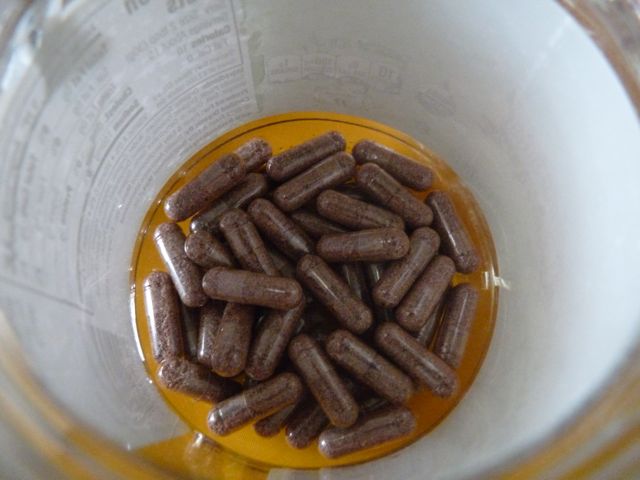
You can hire someone to do it all for you, but with the right equipment you can do it at home for free. Treat the placenta like any other organ you might (and should) eat (liver... liver... liver...), storing it in the fridge in a food-grade container. Start the encapsulation process within 1-2 days after delivery, both for freshness and to start reaping the benefits right away. I wanted my placenta encapsulated raw to preserve the nutrients and life of the organ, but some people steam it first. We got between 150-200 capsules from this effort.

WHAT YOU NEED:
  • A placenta
  • A dehydrator (if you don't have one, search for a tutorial with directions for an oven... and also, if you don't have a dehydrator, put one on your wish list)
  • Capsules and an encapsulator (these are cheap and work well)
  • A handy husband

DIRECTIONS
Rinse placenta thoroughly with water, removing any blood clots and traces of blood.

Make sure it's a handy baby-wearing husband.
You go take a nap or a bath.

Using a knife, remove the bags/membranes from the placenta. It will probably come apart in small pieces, which facilitates the dehydrating.


Dehydrate overnight at about 115 degrees to preserve living enzymes. It should crack apart in your fingers when it's done.


Run the placenta through a good food processor or mill. We used our grain mill.


Encapsulate, following the instructions on your machine.

Load long ends of caps into the base.


Pop a few each day. :)

Wednesday, August 22, 2012

A Post for the Men in Our Lives

I've mentioned before how much I love this Katy lady. She writes a lot of useful things to help women with issues that believe it or not, stem from a misaligned body.

I love her so much I signed up on a mailing list to receive her blog posts in my in-box. That's saying a lot, because I'm a little fanatical about keeping my in-box clean.

Anyway, Katy's posts, as it turns out, are not limited to women and ways to keep our bodies from falling apart! I always knew that they were full of information, which if implemented, would help literally every person who tried. I found this post very interesting because she directly addresses some male issues -- the comment section is interesting as well. I wanted to put a link in this post because I know we all, whether male or female, have men in our lives we love. Perhaps it could help someone. I know Katy has really helped me change some things in my life, (I am 8 1/2 months pregnant, and haven't had incontinence issues in this pregnancy... That's only one of many things that has improved in my recent life) and I am very grateful for the physical changes I've seen and felt as a result of following her advice. She's amazing!

Tuesday, August 14, 2012

A Clove a Day

Does an apple a day really keep the doctor away? I mean, I see the point... eat well to avoid getting sick, right? But it would be more accurate to say:

A freshly crushed clove of raw garlic a day keeps the doctor away!

I know, it doesn't roll off the tongue the same or seem nearly as romantic, but there it is.


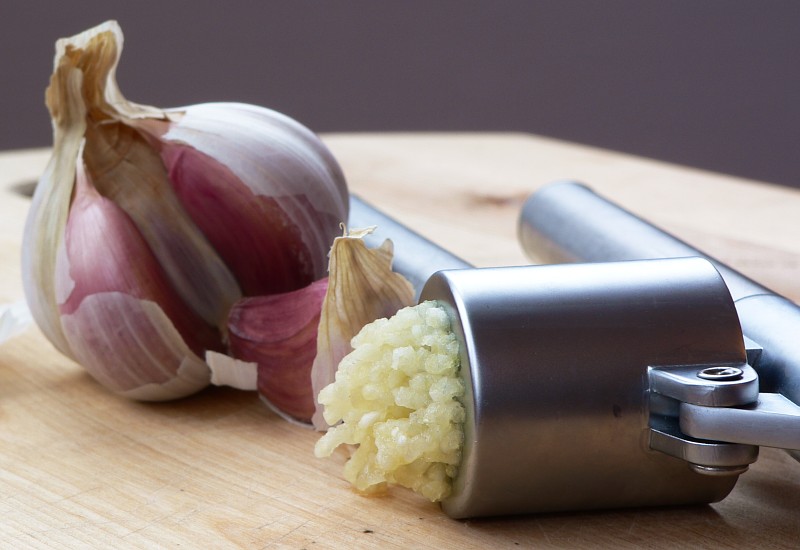
My midwife recommends all her mamas eat a clove or two of garlic each day. I started doing it mainly to see if I could kick a persistent yeast infection when nothing else seemed to work. And work, it did. I kept on taking it, mainly to prevent said yeast infection from returning. I was delighted that it also wiped out a crazy underarm rash (likely this) that developed due to shaving with a sharp razor and sweating too much. I was a quick convert to the wonders of garlic.

I got excited reading various abstracts from garlic studies on PubMed. There are thousands, and I only opened a couple dozen (like this and this...), but the descriptive adjectives impressed me:

Antibacterial
Antiviral
Antifungal
Antiparasitic
Antimicrobial
Insecticidal
Anticarcinogenic
Antitumor
Antioxidant 
Cardioprotective

So looks like we can all benefit! Not just another "thank-heavens-I'm-not-pregnant-so-I-don't-have-to-take-that" supplement. I'll tell my husband next time he gives me a pat on the back for dutifully taking my garlic...

FAQs

In what form should I take it?
For optimal results, raw and fresh are crucial. Crushed is best. Whether it makes a little crunch sound is a good freshness indicator (experience speaking).

You mean, I just eat it?
I generally crush a clove onto a spoon and chase it down with something I need to drink (tea, cal-mag, etc.). Some people spread it on toast or drizzle honey atop.

Will it make my breath smell?
Not nearly as much as I anticipated. People still talk to me and Keenan still kisses me.

What's it like?
It burns ever-so-slightly going down, but it's not unpleasant. It doesn't settle well on an empty stomach (again from experience), especially the gigantic ones.

How often should I take it?
Daily is great. If you want to kick something big, eat a clove every two daylight hours for two days (according to Meredith's healthcare professionals).

How can I do this?
Get a garlic press and one of these to make it less daunting, and then be brave, be brave, be brave! As with most things, the first time takes the most courage.


HAS GARLIC HELPED YOU? HOW DO YOU TAKE IT?

Wednesday, July 18, 2012

Birth Affirmations

Source

A few weeks ago I was visiting with my lovely midwife, and we were discussing mental preparation for birth. She suggested to me that I think of, and write down a list of positive ideas about labor and giving birth -- making sure to write them in the present tense, as if I am experiencing those things at that moment. I am to go back and read them everyday, as part of my preparation. The idea behind this activity being that a person's mind, conscious and subconscious alike, will attach to those thoughts a the person fixates on, and make them a reality. This goes for negative thoughts, as well as positive. Our goal specifically then is to help make a positive birth experience by believing it will happen; by repeating the positive desires I have for my birth, as if they are happening in that moment.

I latched onto this idea, but didn't immediately write my positive thoughts down, (mostly I just forget to do things these days... my brain has temporarily checked out I think). Just a few days ago as I was reading my scriptures I decided it was time to get to making this list. I said a prayer, and began writing. As I did I felt so much power and love from God. He really does love his daughters, and wants us to have good experiences.

I thought it might be a good idea to contact my sisters and ask them what their favorite positive affirmations would be. Their thoughts have been wonderful, and have been added to my own. I thought that I might share my list of birth affirmations here.

My Birth Affirmations:
  • I am full of grace from my Savior
  • My baby is healthy, strong, and wise
  • My body is strong, and knows how to birth my baby
  • My mothers and grandmothers are with me while I am laboring. They support and strengthen me.
  • My body is wise, and knows how to birth my baby
  • I am relaxed and open
  • My uterus is strong and healthy, and is functioning as God intended
  • My uterus continues to stay in my body, where it belongs (I had a slight uterine prolapse with the birth of my son.)
  • My uterus births my children with grace and ease
  • I am holding my new baby
  • Contractions are good, I yield to their strength
  • I am huge
I stole the last one from Ina May's Guide to Childbirth, p.248. She tells of a first time mother who was incredulous that a baby could exit the mother's body through such a small opening. Ina May told her, "You're going to get huge."

I will quote Ina May here (pardon the weird formatting):

"One week later, her son's bottom was just coming into view after seventeen hours of labor. Before his butt pushed directly against her perineum, her vagina enlarged and opened to an extent that astounded me. I had seen this phenomenon in women who had already had seven or eight children, but never before in a first time mother. Judy's vagina would easily have allowed the passage of a baby considerably bigger than her seven-pound eight-ounce sone without a tear.
Some days later when Judy and I were talking about her birth, I told her how surprised I had been to see how open her vagina became without direct pressure on her perineum. (I was still amazed.) Judy said, "I used that mantra you gave me."
"Mantra?" I repeated, uncertain of what she meant.
"I kept thinking while I was pushing, I'm going to get huge. I'm going to get huge!" she said."

Isn't that amazing?

Source

As I was writing my list of affirmations I began having contractions, good strong contractions. They came about every 3 minutes, and though I am only 32 weeks along, I was not frightened. I know my body was reacting to the positive thoughts I was focusing on about birth, and that gives me tremendous joy and hope at the thought of giving birth again. It was a very lovely spiritual experience for me.

Do you have any positive thoughts to add to my list?