Pages

Showing posts with label Book Reviews. Show all posts

Monday, April 21, 2014

Children's Books for Loving the Earth

Over the months, we have discovered a number of children's books (mostly from the library) that have enhanced our love for the earth and our determination to take good care of it. Here are some of our favorites, just in time for Earth Day tomorrow.

Please share the books you and your kids love!

Uno's Garden 
by Graeme Base
Uno watches his beloved forest home slowly transform into a booming metropolis. As the populous grows, the unique indigenous creatures decline. What can be done to save them? Filled with imaginative beauty typical of Graeme Base, this book is also full of fun arithmetic and a wonderful message about the importance of keeping balance with nature.


The Barefoot Book of Earth Tales 
by Dawn Casey and Anne Wilson
This is a beautiful collection of tales from seven diverse countries. The colorful, captivating writing brought me to the edge of tears several times, but my little boys loved them, too! Along with each story is an activity relating in some way to the culture (e.g. make a cornhusk doll, build a willow den, make a mini water garden).


Earth Mother 
by Ellen Jackson, illustrated by Leo and Diane Dillon
In this light-hearted story, Earth Mother goes about ornamenting and caring for the earth in beautiful dress. During her travels, she receives both the thanks and complaints of a toiling man, a frog, and a mosquito, all of whom have insights to gain about the circle of life.


A River Ran Wild 
by Lynne Cherry
This book chronicles the history of the Nashua River in Massachusetts, from the first native settlers to the industrial revolution, which saw factories crop up along it's banks, filling the river with toxic waste. One woman spearheaded a great effort to return the river to its pristine state. (
Incidentally, we recently finished reading the original Boxcar Children books, and one of the books, "Bus Station Mystery," told a very similar story, but without any proper names. It was written around the time of the big cleanup and in the same part of the country, so maybe the Nashua inspired her, too.)

All the Water in the World 
by George Ella Lyon and Katherine Tillotson
A lovely, lyrical presentation of the water cycle.


Brother Sun, Sister Moon: Saint Francis of Assisi's Canticle of the Creatures
by Katherine Paterson, illustrated by Pamela Dalton
Illustrated with watercolored papercuttings, this version of St. Francis of Assisi's famous prayer lends a sweet and strong reminder that God loves his creations and we should, too! 

The Curious Garden 
by Peter Brown
Growing up in a city with no plant life, a young boy discovers some dying plants growing along an abandoned railroad track, and decides to take care of them. As his plants begin to spread, so does his passion to cultivate.

City Green 
by DyAnne DiSalvo-Ryan
A little girl inspires her neighbors to join with her in transforming the old, city-owned, junk-filled lot next to her apartment building into a thriving garden. Besides changing the ugly lot, their efforts also change a heart or two.

Secrets of the Garden: Food Chains and the Food Web in Our Backyard 
by Kathleen Weidner Zoehfeld, illustrated by Priscilla Lamont
This was a fun read about the ins and outs of raising a family garden, including planning, planting, composting, handling pests, and preserving the bounty. Lots of extra information (provided by chickens) includes a helpful discussion on the food web.

Market Day 
by Lois Ehlert
One farmer family takes a day trip to sell their produce at the market. The illustrations are compilations of folk art from all over the world. 

To Market, to Market 
by Nikki McClure
From the perspective of a boy attending attending his local farmer's market with his family, we meet many of the market vendors and learn about the efforts they make to produce their wares.

Brother Eagle Sister Sky 
by Susan Jeffers
Though the origin of this book is controversial (purportedly from a speech by American Indian Chief Seattle), the message about respecting the interconnected web of life is a good one! 


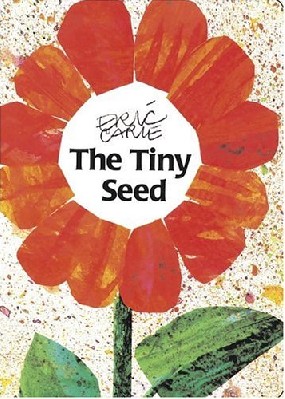
The Tiny Seed 
by Eric Carle
This is a nice story about the life cycle of a seed. One adventurous seed starts out tinier than the others, but in the end grows tallest of all. 

The Apple Pie Tree 
by Zoe Hall, illustrated by Shari Halpern
Two little girls watch the evolution of their family apple tree from bare-branch winter to autumn harvest.

A Promise is a Promise 
by Eve Tharlet
A little marmot becomes best friends with a dandelion, who eventually asks the marmot to blow her seeds to the wind, and trust that everything will be okay. After a lot of worry and a good hibernation, he awakes to a beautiful surprise. 

Anno's Magic Seeds 
by Mitsumasa Anno
A wizard gives Jack two magic seeds. He tells him to eat one and bury the other, promising that it will produce two more in the fall. A mathematical story of the miraculous multiplying and saving potential hidden in every little seed.

Wangari's Trees of Peace 
by Jeanette Winter
After completing her studies abroad, Wangari Maathai returns to her native Kenya to find many of the old forests destroyed. Beginning in her own backyard, she begins planting trees, eventually persuading other women of her town and country to assist in the efforts. They plant 30 million trees. 


Mama Miti 
by Donna Jo Napoli, illustrated by Kadir Nelson
Another take on Wangari, this book shows in dazzling illustration her confident response to the variety of problems coming from women all over Kenya: "Plant a tree!" 

Aside: in 2004 Wangari received the Nobel Peace Prize for her contributions to sustainable development, democracy, and peace. I read her bio on wikipedia and was amazed at her life! There are many earth-lovers who have made similar efforts and sacrifices. You might enjoy learning about:

John Muir
Rachel Carson
Jacques Cousteau
Gaylord Nelson
And many more, I'm sure!

Here are a few more books that are either educational (without a storyline) or compilations of earth-centered activities. You might like:

One Well: the Story of Water on Earth 
by Rochelle Strauss, illustrated by Rosemary Woods
Earth's water supply is essentially one big well. This book talks all about water: the water cycle, our collective need for water, access to water, water pollution, and becoming "well aware."

What's So Special About Planet Earth? 
by Robert E. Wells
This book encourages kids to value our world by taking a look at how it is suited uniquely for us. At the end he shares some ideas for conserving resources and using energy wisely.

Best Kids Love-the-Earth Activity Book 
This is a terrific compilation of ideas for understanding and exploring the earth. Here is just a smattering from this book: design a nature collage, pound a leaf into fabric, make sun tea, make fresh water from salt water, make wind-powered music, make a bird hangout, host a party for the planet, dye earth-friendly easter eggs (which I tried this year, though not from this book), and LOTS of ideas for reusing various materials.

My First Green Book: A Life-Size Guide to Caring for our Environment 
by Angela Wilkes
Though a little old-school, this book has some good stuff. It includes information on an array of subjects ranging from waste disposal to the rain forest and features activities such as testing your own water and soil, making a water filter, creating a wildlife garden, and campaigning for change.

Love Your World: How to Take Care of the Plants, the Animals, and the Planet 
by Dawn Sirett
This was a favorite for my kids. It contains lots of colorful pictures and little poems about loving and caring for the earth, encouraging kids to make a difference!

HAPPY EARTH DAY!!
(You can celebrate Earth Day as long as you want.)

Sunday, April 6, 2014

Start Planning Easter!

Easter is right around the corner. With it comes great potential for deepening your family's relationship with Jesus Christ and better understanding his great mission.

Last year I wrote a review of a fabulous guide for celebrating a Christ-centered Easter. If you haven't already, you might consider purchasing the book* for the upcoming Holy Week. (I included several ideas from the book in the original post.)


Even with last-minute planning and a husband out of town, I was able to try many of the ideas and activities with my young sons last year. We all enjoyed it and felt closer to each other and to our Savior. We read scriptures, stories, discussed the events of each day of the week, learned about the customs and rituals of the Jews, listened to sacred music, acted out events and parables, made the food of the time, and even had delicious sole and honeycomb for our simple Easter dinner (which I liked preparing so much more than the leg of lamb I did a previous year!). Yet we barely scratched the surface of this book.

What about conventional Easter celebrations? We completely left them out (my kids had never heard of the Easter bunny, so they weren't left wondering). Our week involved so many interesting activities, I don't feel we missed out. This year we might color eggs and have a basket hunt on Saturday the 12th (the day before Palm Sunday) as a celebration of spring and precursor to the true Easter festivities. (I like the idea of doing this on the first day of spring, but we were out of town that week and couldn't swing it.)

Making unleavened bread

After the holiday last year, I followed up with the author about the book review post, and she shared a few other ideas they have implemented since publishing their book. From Janet Hales:
How did your Easter turn out?  Easter day is my favorite -- the compilation of everything we have done and thought of during the week.  We have added two things to our family worship that have been very significant for me: on Saturday, those who can, attend the Temple, to help in the vicarious work now afforded us.  This is such a meaningful activity to me.  On Sunday, those who wish give an "Easter Offering" they have been independently working on throughout the week.  One year I wrote a Psalm of praise, this year it was free verse about Living Water; Joe wrote a lovely piece about "Why Is this Night different than all other nights?" (A question from the script of the Passover Dinner), Kate sang "I Stand All Amazed."  Years ago, one of our young boys had made an "empty tomb" out of Lego.  This was really a reverent and beautiful part of our ending devotional this year.  
The book contains such an abundance that you'll already have to pick and choose, but you might also find yourself thinking of things on your own. Whatever you do, make a plan ahead of time that will work for your family and above all, enjoy this beautiful Easter season! Please share how it turns out.

*No, I'm not getting any kickbacks. ;)

Wednesday, February 19, 2014

8 Outstanding Books to Help Us Appreciate Our Civil Rights

My cousin Ben married a lovely girl, Celeste.  (I actually take full credit for their successful marriage, because after his mission, Ben moved to the apartment complex I recommended, which is where he met her.)  They now have two darling sons (the older of the two looks just like Ben).  

Celeste is an avid reader, and a wonderful writer.  She has a new blog, celestereads.com that is really fun.  She is up on good reads her young boys, as well as for herself.  With her permission, I'm re-posting here her post:

8 Outstanding Books to Help Us Appreciate Our Civil Rights


Maybe it's just me (but pretty sure it's not), but I sometimes blow off Martin Luther King Jr. Day itself. It's easy to just be relieved for any old holiday off during dreary January. So the past few years, I've started a bit of a tradition to remember the important cause we're celebrating. **A shocker coming** I read a book.

In turn, I've found some of the most affecting books I've ever read. I recommend choosing one to read this month to help truly appreciate our freedoms!
Iran Awakening by Shirin Ebadi
An Iranian judge made to step down with the start of the Iranian Revolution, Nobel Peace Prize winner Shirin Ebadi tells her story of trying to create change in her beloved country. 
Gandhi: His Life and Message for the World by Louis Fischer
After seeing the movie that got Best Picture, I had to know more about the Mahatma's life. This was my favorite of the ones I read.
Nothing to Envy: Ordinary Lives in North Korea by Barbara Demick
The engaging and retching stories of six North Korean defectors. Full review here.
Wild Swans: Three Daughters of China by Jung Chang
An incredible book of three generations of women in 20th century China. From foot-binding to idealistic communists, then the Cultural Revolution. It's all covered here within the perspective of this grandmother, mother and the author herself.
Tree Shaker: The Story of Nelson Mandela by Bill Keller
Written for a juvenile audience, this is an easy read to appreciate the leadership and sacrifice of recently departed Nelson Mandela.
Persopolis: The Story of a Childhood by Marjane Satrapi
A graphic novel telling the story of a young girl in revolutionary Iran.
Escape from Camp 14: One Man's Remarkable Odyssey from North Korea to Freedom in the West by Blaine Harden
The only person ever known to survive an escape from a North Korean labor camp, the chilling story of his life.
Mayada: Daughter of Iraq by Jean Sasson
One girl's up-close and personal associations with Saddam Hussein and her life in his Iraq. Many gruesome scenes and some graphic descriptions, but as it is real life, I thought it was worth reading through the gore.

Or if time is short, there's always King's powerful "Letter from Birmingham Jail".

You might notice the notable absence of books on American civil rights. I need to right that. Any recommendations?

Thursday, November 21, 2013

On Books

Andrew and I read together last night an old email from his wonderful scholarly father that was a wonderful compilation of quotes from church history about books and study.  Enjoy!

Hugh Nibley, Approaching Zion 296

We are commanded in D&C 109:14-16 . . . to build a house of study.  There people were to "seek . . . out of the best books words of wisdom" (D&C 88:118).  A list of the best books had not yet been supplied.  We must find these ourselves by diligently searching.  If the scriptures bind the worlds together, the writings of man bind together the generations and the dispensations.

Joseph F. Smith, Gospel Doctrine 235

Read good books. Learn to sing and to recite, and to converse upon subjects that will be of interest to your associates, and at your social gatherings, instead of wasting the time in senseless practices that lead only to mischief and sometimes to serious evil and wrongdoing; instead of doing this, seek out of the best books knowledge and understanding. Read history. Read philosophy, if you wish. Read anything that is good, that will elevate the mind and will add to your stock of knowledge, that those who associate with you may feel an interest in your pursuit of knowledge and of wisdom.
Teachings of Ezra Taft Benson 304

With the abundance of books available, it is the mark of a truly educated man to know what not to read. "Of making many books there is no end" (Ecclesiastes 12:12). In your reading you would do well to follow the counsel of John Wesley's mother:  Avoid "whatever weakens your reason, impairs the tenderness of your conscience, obscures your sense of God, takes off your relish for spiritual things, [and] increases the authority of the body over the mind."

The fact that a book or publication is popular does not necessarily make it of value. The fact that an author wrote one good work does not necessarily mean that all his books are worthy of your reading. Do not make your mind a dumping ground for other people's garbage. It is harder to purge the mind of rotten reading than to purge the body of rotten food, and it is more damaging to the soul.
Brigham Young, JD 9:174, January 26, 1862

Novel reading--is it profitable? I would rather that persons read novels than read nothing. There are women in our community, twenty, thirty, forty, fifty, and sixty years of age, who would rather read a trifling, lying novel than read history, the Book of Mormon, or any other useful print. . . . I would advise you to read books that are worth reading; read reliable history, and search wisdom out of the best books you can procure. How I would be delighted if our young men would do this, instead of continually studying nonsense.
As a side note, there were also two interesting and relevant food news stories on NPR this morning, one bad one good:


I can't find the original NPR story, but this is about the same study

Nut consumption reduces risk of death

Saturday, September 7, 2013

Lark Galli's Women's Conference Talk

Meredith had a great post a month ago called "Body Love."  Loving our bodies is something I've thought a lot about, especially since I have had children, particularly a girl. How can I teach my children to have a deep appreciation with their bodies?  How can I teach my daughter to think her body is beautiful? My mom, Lark Galli, gave a wonderful women's conference talk this year on the topic, and she said I could post it here for any people who might be interested.
But first, a free plug for her wonderful new book!  It's called "Under a Leafless Tree: The Story of a Mormon Girl from East Prussia."  It's a compilation of stories she recorded for the last ten years of a remarkable woman in her ward who had amazing experiences as a young mother during WWII.

And now, her talk:

Dear Sisters, I’m grateful to be with you and Sister Rosenlof this afternoon. After dropping our daughter off at high school last week, my husband, our bishop, called me. He just had to tell me how sad he was to see the young women walking into the school wearing such short shorts and short skirts. “I worry for the girls and the boys, he said.” These young women, many of them members of the church, are stuck between trying to meet standards set for them by the world, and those anchored in the gospel.
As you know, since earth’s first days, Satan has sought to turn women from their true identity. Our great grandmothers suffered these afflictions in every land and time. And as we also know, Satan still rages against women. But though the battle is fierce, he will lose it, and he is losing it, because of the restored gospel, and the power of our Redeemer.
Around 1830, the dawning light of the gospel began to peel back the old veil of darkness, exposing to those with ears to hear and eyes to see ancient lies about the nature of women and men and revealing their true destiny. Today, we’ll consider just a few of these doctrines, and how they can strengthen us as women so that we can reject the world’s false standards while helping others to do the same. 
I agree with Wordsworth that most of us arrive on earth happily, “trailing clouds of glory from God, who is our home.” This makes me think of a young woman with whom I recently spent a few days. She is balding, heavy for her age, and somewhat physically challenged. Her speech is limited, yet she is uncommonly self-assured, willing to shine her smile on those around her. Her name is Evelyn Bea, and she is 7 months old. Many infants and children like Evelyn Bea seem to know that they are naturally beautiful, wise and good, but that enthusiasm inside most of us suffers before too long in this wilderness of earth.
Many years ago I entered a bedroom and discovered a thirteen-year old girl sitting quietly and very sadly in front of a mirror, her eyes red from crying. She meant so much to me, and her sadness was so evident that I have felt its pain through all these years. I’m not sure what her troubles were that day, but I’m pretty sure she did not like what she saw in that mirror. To paraphrase Wordsworth again, “shades of the prison-house begin to close upon the growing (girl),”  resulting in very sad looks in the mirror for many young women. For some of us, the sad looks and feelings never stop.
The restored gospel holds the keys to our recovery. Through it, we discover knowledge that has been long forgotten: namely, that we are literal daughters of Heavenly Parents, in their very image. This identity as divine women can never under any circumstances at all be removed from us. The proclamation about the family makes this clear. “All human beings—male and female—are created in the image of God. Each is a beloved spirit son or daughter of heavenly parents, and, as such, each has a divine nature and destiny. Gender is an essential characteristic of individual premortal, mortal, and eternal identity and purpose. “  
Thus, as Latter-day Saint women, we know that we have a long, unremembered history as spirit daughters in our Heavenly Parents’ realm, and we will continue to be theirs after we leave this world, every one of us. Like the queens and princesses of fairy tales, no matter how dirty, lost, or unrecognized, or even badly behaved we may be on earth, we are of divine lineage. That is permanent. Though at times we may feel like ugly ducklings, that will not change the reality that genetically we are swans. We are by nature divine women.
This knowledge explains our high standards of behavior in the Church, and can bless us every day as we build our lives upon it. Elder Jeffrey R. Holland said, “I want you to be proud you are a woman. I want you to feel the reality of what that means, to know who you truly are. You are literally a spirit daughter of heavenly parents with a divine nature and an eternal destiny. That surpassing truth should be fixed deep in your soul and be fundamental to every decision you make.”  
In many ways, Sister Elaine Dalton exemplifies to me a woman who embraces and shares this truth, as she did this last conference. We have heard her clarion call for virtue, and her confident declarations that one virtuous woman can change the world. We have seen her dedication to personal purity. Hers is a path of holiness. Her example of divine womanhood strengthens me, and I’m grateful to her for reminding us of our true worth.
Through doctrines of the restoration, we have also learned that motherhood is part of our divine capacity; not the motherhood the world sees as a temporary job, but the motherhood that is our nature, as Fatherhood is the nature of our Heavenly Father. As women, this is an aspect of our identity regardless of whether we have born children here on earth. I have long loved what Elder Holland’s wife Sister Patricia Holland said on this subject: “Eve was given the identity of 'the mother of all living'— years, decades, perhaps centuries before she ever bore a child. It would appear that her motherhood preceded her maternity…. I believe mother is one of those very carefully chosen words, one of those rich words— with meaning after meaning after meaning…. It is first and foremost a statement about our nature, not a head count of our children.  
The meanings in this rich doctrine of motherhood are beyond the scope of our discussion for today, but we can remember it when we make daily decisions. It reminds me of a young mother and an everyday adventure she recently told me. See if you can picture this. She was on a rare shopping trip with her four year old and two year old little boys and her beautiful baby daughter, who was riding heavily on her hip. Slung somewhere on her arms were her diaper bag and bags of her purchases. At the top of an escalator, the two year old, who was holding the hand of the four year old, lost his balance and started to fall, threatening to send the entire bunch tumbling down the steps. The four year old kept hold on his brother, but couldn’t keep his ground, either. As the boys began to fall, somehow their mother hoisted the entire pack of babes and bags to safety in the nick of time. While recovering from the scare and assessing his own profound strength, the four year old turned, looked at his mom in amazement and said, “You are strong. You are very strong!” to which she replied, “Yes, I am very strong.” I love that she said that, and I told her so! She told me that as she goes throughout her days, she repeats the phrase often, sometimes out loud: “I am very strong”. That is a powerful affirmation of her nature as a mother. As I observe her, I believe that her strength comes because she is firmly rooted in her divine nature, both physically and spiritually. 
In what other area of women’s lives could the world’s and the Lord’s standards be more at odds than how we view and use our bodies? Through the gospel we understand that, lacking a body himself, Satan distorts the true beauty of women as he prompts them to disparage and abuse their bodies at every age. Through the media, he promotes impossible standards and grotesque notions of attractiveness, many of which require damaging or immodestly displaying our bodies. 
The other day I was in and out of clothing stores and noticed that almost all of the clothes on the mannequins were pinned several inches in the back around the midsection, making them appear thinner than they would on an actual person. That means that any time 99% of us put on the same clothes, they will look different on us, and maybe not so good to our eyes. That’s just one little discouraging trick in Satan’s toolbox. With the Holy Ghost, we can know him for who he is, and refuse to let him determine how we view our bodies. 
Through revealed doctrine, we know that our bodies are essential elements of our eternal souls. How it would astonish the world to learn that our bodies make us more, and not less like God! The Doctrine and Covenants teaches that, “The spirit and the body are the soul of man [and woman]” (D&C 88:15), and that “Spirit and element together receive a fullness of joy” (D&C 93:33). The prophet Joseph Smith further taught, “The great principle of happiness consists in having a body.” 
Knowing this, we can set aside impulses to despise and damage our bodies and instead truly enjoy them, for we are their inseparable partners forever. Which actually reminds me of the thirteen year old with the red eyes sitting before the mirror that I mentioned earlier. Guess what? She grew up! In the years after that sad day, that girl began to lay hold on the gospel, and she became happier. Now as a mother and grandmother she lives in and enjoys her body. She sings, and teaches refugees to speak English. She employs her feet, back, and hands to plant and share harvest from her garden, and her mind to study. Almost daily, rain or shine, she opens her front door and launches out into a nearby canyon or neighborhood on foot, bicycle, or even on a scooter. She listens to her body and strives to keep it well. As she does this, her contentment with who she is radiates. Simply by her example, she is blessing the women around her.
I’m a little bit behind her. Can we get right to business and talk about the swimsuit test? The other day I was in a crowded swimming pool, playing with our family. I became self-conscious about how I looked in my swimsuit. Is it my imagination, or is this an almost universal story? With my proportions, I have always felt a little funny in a swimsuit, and as I age, I have found more reasons to do so. So I began to feel self-conscious, and somehow even ashamed. I wasn’t having fun. Then I stopped and looked around. I considered that of dozens of swimmers in the pool that day, I was the person who cared the most about how I looked. If fact, I might have been the only one who cared at all! Others were probably just fine seeing another grandmother in the pool in a grandmother body. Our grandson only cared that we were together, and that I was willing to go down the big slide with him. I thought I’m a grandma because I worked hard for a long time at being a mama. Being a grandma is a gift. It’s OK to look like one. This little lecture wasn’t easy to give myself, but it helped. I felt I had won a small victory. 
These beautiful doctrines of the divine nature of women can bless us, but could also discourage us, if, like I did at the pool, we feel we are very far from that potential, and so inundated by forces against our happiness. So what is the true source of our confidence while we wait for perfection? The Source is the Lord Jesus Christ, and His almighty Atonement. In it lies every righteous hope of every woman on earth. Our growing understanding of the Atonement is the best gift of the restoration of the gospel. Sisters, I wish we could speak only of Jesus Christ and His love today. As it is, I testify with you, for you know it too, that our freedom as women lies in His saving grace, which we experience every day. I like what Brother Brad Wilcox, who speaks here tomorrow, says. “Christ said, ‘Follow me, and I will make you fishers of men’ (Matthew 4:19), but let’s occasionally leave off a few words and hear Him saying, ‘Follow me, and I will make you.’”   I truly love that: “Follow me, and I will make you!”
By following the Lord, we will reach our destination as divine women, and along the way, strengthen others. The path is familiar and well worn, and marked by covenants and promises. It leads directly through the temple. The temple is the earthly type of our Heavenly Home, a welcome refuge from the world, a House of Glory and a House of God. There we find these truths of our divine nature in clarity, and we commune with our Heavenly Parents. As I considered Sister Dalton, the young mother at the top of the escalator and the grandma on the scooter, to my surprise, I realized they have something in common: all three of them anchor their lives in the temple. It is a centerpiece of their worship. From there they frequently go forth armed with power, with the Lord’s name upon them, and His glory round about them.  Through the temple they are becoming godly women. 
Sisters, I have felt that we here in this room today are well on our paths to uncovering our divine potential. That’s what the gospel does. It’s what Women’s Conference is about, too. We should be encouraged by our progress! As we strive to keep our covenants and worship in the temple, we are following our blueprint home. This progress is probably easier to see in others than in ourselves, so look around at the godly women on either side of you, and in the various classrooms, and be encouraged. Most likely, you are one of them, a Latter-day Saint woman of faith.
My experience is that as we increasingly embrace our own divine potential, we come to see potential more readily in every other person, beginning with those who are nearest to us: our husbands, parents, children, co-workers, and neighbors. We realize more profoundly that each of them is an eternal being, too, and we become less critical. Suddenly no one at all is too old, too uneducated, too unattractive or too different from us, for we have grown in the gift of charity. And this charity encompasses even ourselves! 
Not long ago, our daughter reminded me that it is not very convincing if we tell our daughters, granddaughters and Young Women, “You are beautiful, but I am not,” “You are important, but I am not.” “You are smart, but I am not.” I was forced to admit that my daughters would benefit much more from my confidence than my insecurities. And my confidence is rooted in my covenant partnership with the Author and Finisher of my salvation, He who heals every woman.
It is our healing, after all, and not our perfection, which will inspire the healing of others. As former professor of ancient scripture Catherine Thomas says, “Why do some of us learn valuable parenting lessons after it seems mostly too late to incorporate them? Perhaps because it is never too late, really, in the eternal scheme of things. It seems that when Mother gets better, everyone in the family gets better—no matter how old the children are.”  She says, “I have learned that it is a true principle that I needed to fix myself before I could begin to be truly helpful to anyone else. . . . I learned that I had to focus on getting well and leave off trying to cure anyone around me!”  
I hope we consider the impact of our healing on the lives of other women. As simple as it sounds, our own happiness and well-being can help them counter Satan’s lies that women are unattractive, powerless or ineffective. Sisters, the doctrines of divine nature, which we love, can be difficult for our younger sisters in the gospel to lay hold on, and they are simply unavailable to the great majority of the women of the world. We must remember that we can help, just by believing in and embracing them ourselves with our Savior at our sides. 
The influence of Latter-day Saint women on the women of the world is a matter of prophecy. If you’re sort of old, like I am, you might remember hearing President Kimball say these words to the women of the Church. They have never left my mind: “Finally, my dear sisters, may I suggest to you something that has not been said before or at least in quite this way. Much of the major growth that is coming to the Church in the last days will come because many of the good women of the world (in whom there is often such an inner sense of spirituality) will be drawn to the Church in large numbers. This will happen to the degree that the women of the Church reflect righteousness and articulateness in their lives and to the degree that the women of the Church are seen as distinct and different—in happy ways—from the women of the world.” 
That is our challenge: to reflect righteousness, and be seen as distinct and different—in happy ways—from the women of the world. So we are supposed to be peculiar! And we will be noticed more and more. Just ask your teenager! The women of the world, including our own young women in the short shorts and skirts in our neighborhoods, are fighting a tsunami of opposition to their divine nature. Please look around, and you will see it. Waves of sexualization, trivialization and distraction wash over them at work and school and home. As Latter-day Saint sisters, mothers and grandmothers, we can plant ourselves on the solid rock of our Redeemer, raise the lanterns of our faith, and reach into the surging waters for their hands. 
As I mentioned at the beginning, with the restoration of the gospel in 1830, shadows on the lives of women began to flee. Not just for Latter-day Saints, but for all of the women in the world! This is a stunning truth. The restored gospel has truly brought the dawning of a brighter day, and with our young and growing army of sister missionaries; its light is surely growing brighter.   I feel so very excited for the good that they will do. They were prepared to share their lights, and so are we. Our acts may seem small, but their effect will be great. 
Speaking of the organization of the Relief Society, President George Albert Smith declared to the women of the Church, “You are … more blessed than any other women in all the world. You were the first women to have the franchise; the first women to have a voice in the work of a church. It was God that gave it to you and it came as a result of revelation to a Prophet of the Lord. Since that time, think what benefits the women of this world have enjoyed. . . . When the Prophet Joseph Smith turned the key for the emancipation of womankind, it was turned for all the world.”  This last line is quoted in the book, Daughters in My Kingdom: “When the Prophet Joseph Smith turned the key for the emancipation of womankind, it was turned for all the world.” 
Sisters, we have a prophetic work to do. Our foreordained assignment is to lead the way forward as women who know themselves and understand their heavenly origin, despite opposition from earth and hell. We will be seen as daughters of Christ who abide in Him. The strength and well being in our lives is and will be a beacon for women everywhere. We must not make the mistake of underestimating our influence. I am reminded of a quote by J. R. R. Tolkien: “Such is oft the course of deeds that move the wheels of the world. Small hands do them because they must, while the eyes of the great are elsewhere.”  
If I could show you my heart, it would declare that our Heavenly Parents love their daughters. They know that before our Savior descended below all things, we, their daughters, fell too, seemingly far from their loving embraces, and we lost our way. Our Heavenly parents have heard the cries of all the women of the world. And through the gospel, they have restored precious knowledge of whom and whose we really are. By living in accordance with our true identity, we can light the path for our sisters of all generations on earth. “And God shall wipe away all tears from their eyes; and there shall be no more death, neither sorrow, nor crying, neither shall there be any more pain: for the former things are passed away,”  leaving joy in their place. In the name of Jesus Christ, amen.

Tuesday, July 30, 2013

The Poems of Alan Alexander Milne

Jonathan Jo
Has a mouth like an "O"
And a wheelbarrow full of surprises;
If you ask for a bat,
Or for something like that,
He has got it, whatever the size is.

If you're wanting a ball
It's no trouble at all;
Why, the more that you ask for, the merrier––
Like a hoop and a top,
And a watch that won't stop,
And some sweets, and an Aberdeen terrier.

Jonathan Jo has a mouth like an "O"
But this is what makes him so funny:
If you give him a smile,
Only once in a while,
Then he never expects any money!


Some of my strongest childhood memories include the poems of English writer A.A. Milne (1882-1956). I can still hear my dad's voice reciting "Lines and Squares," "Disobedience," and "Jonathan Jo" and my mom's voice in "The King's Breakfast" and "The End." I'm sure I say them to my children now with the exact intonation my parents once spoke them to me. Many other Milne poems adorned my childhood in some way or another (e.g. King's Singers albums, Muppets sketches...).

Best known for his stories about the adventures of Winnie-the-Pooh in the Hundred Acre Wood, A.A. Milne's poems are absolutely not to be missed. I never tire of them. Based on my memories of childhood and observations of my own little boys, I think he thoroughly understand the workings of a child's mind and heart (in fact, for this reason, all adults should read them). Ernest Shepard's accompanying "decorations" are equally charming. Whether or not you have children at home, the poetry books When We Were Very Young and Now We Are Six are worthy additions to precious bookshelf space.

Call any nearby children to your knee right now and enjoy a few of my favorites together. If you are alone, no matter. You might be pleased to catch a glimpse of yourself in some of these words.

Market Square

I had a penny,
A bright new penny,
I took my penny
To the market square.
I wanted a rabbit,
A little brown rabbit,
And I looked for a rabbit
'Most everywhere.

For I went to the stall where they sold sweet lavender.
("Only a penny for a bunch of lavender!")
"Have you got a rabbit, 'cos I don't want lavender?"
But they hadn't got a rabbit, not anywhere there.

I had a penny,
And I had another penny,
I took my pennies
To the market square.
I did want a rabbit,
A little baby rabbit,
And I looked for rabbits
'Most everywhere.

And I went to the stall where they sold fresh mackerel.
("Now then! Tuppence for a fresh-caught mackerel!")
"Have you got a rabbit, 'cos I don't like mackerel?"
But they hadn't got a rabbit, not anywhere there.

I found a sixpence
A little white sixpence.
I took it in my hand
To the market square.
I was buying my rabbit
(I do like rabbits)
And I looked for my rabbit
'Most everywhere.

So I went to the stall where they sold fine saucepans.
("Walk up, walk up, sixpence for a saucepan!")
"Could I have a rabbit, 'cos we've got two saucepans?"
But they hadn't got a rabbit, not anywhere there.

I had nuffin',
No, I hadn't got nuffin',
So I didn't go down
To the market square;
But I walked on the common,
The old-gold common . . .
And I saw little rabbits
'Most everywhere!

So I'm sorry for the people who sell fine saucepans,
I'm sorry for the people who sell fresh mackerel,
I'm sorry for the people who sell sweet lavender,
'Cos they haven't got a rabbit, not anywhere there.


Happiness

John had
Great Big
Waterproof
Boots on;
John had a
Great Big
Waterproof
Hat;
John had a
Great Big
Waterproof
Mackintosh––
And that
(Said John)
Is
That.


Come Out with Me

There's sun on the river and sun on the hill . . .
You can hear the sea if you stand quite still!
There's eight new puppies at Roundabout Farm––
And I saw an old sailor with only one arm!

But every one says, "Run along!"
(Run along, run along!)
All of them say, "Run along! I'm busy as can be."
Every one says, "Run along,
There's a little darling!"
If I'm a little darling, why don't they run with me?

There's wind on the river and wind on the hill . . .
There's a dark dead water-wheel under the mill!
I saw a fly which had just been drowned––
And I know where a rabbit goes into the ground!

But every one says, "Run along!"
(Run along, run along!)
All of them say, "Yes dear," and never notice me.
Every one says, "Run along,
There's a little darling!"
If I'm a little darling, why won't they come and see?


Knights-in-Armor

Whenever I'm a shining Knight,
I buckle on my armor tight;
And then I look about for things,
Like Rushings-Out, and Rescuings,
And Savings from the Dragon's Lair,
And fighting all the Dragons there.
And sometimes when our fights begin,
I think I'll let the Dragons win . . .
And then I think perhaps I won't,
Because they're Dragons, and I don't.


The Engineer

Let it rain!
Who cares?
I've a train
Upstairs,
With a brake
Which I make
From a string
Sort of thing,
Which works
In jerks,
'Cos it drops
In the spring,
Which stops
With the string
And the wheels
All stick
So quick
That it feels
Like a thing
That you make
With a brake,
Not string . . .

So that's what I make,
When the day's all wet.
It's a good sort of brake
But it hasn't worked yet.


Vespers

Little Boy kneels at the foot of the bed,
Droops on the little hands little gold head.
Hush! Hush! Whisper who dares!
Christopher Robin is saying his prayers.

God bless Mummy. I know that's right.
Wasn't it fun in the bath tonight?
The cold's so cold, and the hot's so hot.
Oh! God bless Daddy––I quite forgot.

If I open my fingers a little bit more,
I can see Nanny's dressing-gown on the door.
It's a beautiful blue, but it hasn't a hood.
Oh! God bless Nanny and make her good.

Mine has a hood, and I lie in bed,
And I pull the hood right over my head,
And I shut my eyes, and I curl up small,
And nobody knows that I'm there at all.

Oh! Thank you, God, for a lovely day.
And what was the other I had to say?
I said, "Bless Daddy," so what can it be?
Oh! Now I remember. God bless Me.

Little Boy kneels at the foot of the bed,
Droops on the little hands little gold head.
Hush! Hush! Whisper who dares!
Christopher Robin is saying his prayers.


Do you have a favorite you'd like to share?
What other children's poets do you love?