Pages

Showing posts with label Earth. Show all posts

Monday, July 20, 2015

Utah Natural Meat -- Shop Here if You are Able


Utah Natural Meat
7400 S. 5600 W. West Jordan, UT
       I wanted to make a quick shout out to a local haunt my family adores. Utah Natural Meat is the farm where we purchase our meat. Shayn and and Kristen Bowler are third generation owners and operators of this little family business. And when I say little, well, I mean tiny as businesses go these days. They hire temporary help here and there, but they employ only one regular staff member. This is a true family business, and has been in the family since the 1940's.

Some of the things I love about about this little family and farm:
  • They are so obviously hard working. They go out of their way to make sure their customers are happy. And at times when I've been pregnant, they have always gone out of their way to make my visit as easy as possible.
  • They are honest. I was chatting one day with their worker as she checked out the packages I was buying. The conversations went something like me saying, "I really love this store. The family has always seemed so great!" To which their worker said something like, "Oh, I love working for the Bowlers. They are beyond scrupulous. It is just so nice working for people who are so concerned with being honest about the way they operate." Conversations like this say a lot to me about a business owner. I'm sold.
  • They sell a variety of meats, and have very reasonable prices. You will find beef, pork, lamb, goat, chicken, and turkey. They sell the muscle meats, which are awesome, but they also sell organ meats (liver, kidneys, and heart), fat from pigs and beef for rendering into lard and tallow, and bones.

  • They sell eggs pastured eggs! Walking up the the store you will often see a variety of chickens meandering around.

  • Speaking of that, all of their animals are pastured. As you drive up to the store you will see fields with pigs running around, mother cows with their calves, a tiny little donkey named Pepper, two draft horses, King and Duke. (We recently went to a family day at the farm and got a wagon ride with these beautiful horses. Amazing animals.) They often times will have turkeys wandering around too. And our favorite, the farm dog, Maggie. She is just the sweetest fuzzy girl.

Shayn with Duke and King
  • Another great thing about family operations like this is they are a family. They have children the same age as mine, and so all of these animals are accustomed to children and their antics. I love going there and seeing toy tractors all over the place, and knowing that I can let my kids wander while I grab what I need. Maggie thrives on the attention the kids pour on her.

  • They specialize in a heritage breed of cattle called corriente. If you click on the link to their website, you can read there all the great things about the corriente breed. I can testify, it is excellent quality beef, and again, the price cannot be beat.
  • Along with their animal ventures, they also grow vegetables to sell in the summer and fall months, and they have local bee keepers, and artisan soap and cheese makers who sell their wares in the farm store as well.
  • Oh, and they grow all their own feeds for their animals. Yes. I know, can real people be this fabulous? Non-GM alfalfa, and during the winter they have a green fodder system so the animals get greens year round. Bless them.*
      So there you have it. I am an advocate for buying locally, and wanted to get the word out there about this fantastic family and their little store. We can't raise all of our own meats yet. In the mean time (whatever that means) we feel good about our purchases here, knowing the animals raised here have good lives in sunny fields free to roam, with good real foods to eat. 

Thank you, Kristen and Shayn!

*Utah Natural Meat is not organic certified, however, they do use non-GM, corn/soy free feeds for all of their animals. You can read about their choice to remain uncertified here.

Note: It appears I forgot to mention Utah Natural Meat's store hours. They are open Thursdays 2:00pm-5:30pm, and Saturdays 9:00am-12:00pm.

Tuesday, April 29, 2014

The Soggy Lettuce Conundrum (and How to Stop It)

Sometimes I lose produce before I can use it.

Well, it actually happens less often since I stuck this nifty sticky whiteboard to my fridge. Now I write down all our produce and perishable leftovers so I remember what's going on in my kitchen (both in and out of the fridge).

I took this photo back in January (probably after a CSA box 
or a trip to the Farmer's Market since there's so much on there).

I have always hated losing produce. It's such a waste, not only of the food itself, but of everything it took to grow that food.

I recently watched this TED talk by Leyla Acaroglu called Paper beats plastic? How to rethink environmental folklore. I think all 18 minutes are worthwhile. I've watched it twice.


Toward the beginning of the talk, Acaroglu points out that biodegradability is "a material property, not a definition of environmental benefit." That got me slowly nodding my head. She went on:
When something natural [like food waste or paper] ends up in the natural environment, it degrades normally. Its little carbon molecules that it's stored up as it was growing are naturally released back into the atmosphere as carbon dioxide. But this is a net situation. Most natural things don't actually end up in nature. Most of the waste that we produce ends up in landfill. Landfill is a different environment. In landfill, those same carbon molecules degrade in a different way because a landfill is anaerobic. It's got no oxygen. It's tightly compacted and hot. Those same molecules, they become methane, and methane is a 25x more potent greenhouse gas than carbon dioxide. So our old lettuces and products that we have thrown out that are made out of biodegradable materials, if they end up in landfill, contribute to climate change.
Whoa, what? When I throw the soggy lettuce in the trash, it's destiny is methane? When I toss a piece of paper in the trash, it's destiny is probably methane?? Why did this never occur to me?

Realizing this actually made me glad about two things.

First, that we compost, which means that this:


turns into this:


We use it to enrich the soil and feed the earthworms. :)

However, when the compost tumbler is a-tumbling, I don't add anything to it for several weeks (which is why having two would be awesome). So, second, when I can't add my biodegradables to the composter, I typically toss them behind these lovely bushes in the front yard. 


Here's a close-up:


When I started doing this over a year ago, I figured that even though I couldn't use the compost how I'd like, I was still feeding the earth. Something beautiful will grow there some day.

I'm happy to have another way to care for the earth in my arsenal, and a good reason for doing so!

If composting isn't an option for you at the moment, is there somewhere else you can toss those kitchen scraps so they don't wind up in a landfill? If you don't have a yard, you could always add your scraps to broth or soups to get more life out of them. I bought an eBook bundle once that included one called Don't Compost It, Cook It. I haven't read it thoroughly, but the the author has some good ideas for getting as much mileage as possible out of your food.

How do you avoid losing produce? How do you make use of any peelings and trimmings?

Monday, April 21, 2014

Children's Books for Loving the Earth

Over the months, we have discovered a number of children's books (mostly from the library) that have enhanced our love for the earth and our determination to take good care of it. Here are some of our favorites, just in time for Earth Day tomorrow.

Please share the books you and your kids love!

Uno's Garden 
by Graeme Base
Uno watches his beloved forest home slowly transform into a booming metropolis. As the populous grows, the unique indigenous creatures decline. What can be done to save them? Filled with imaginative beauty typical of Graeme Base, this book is also full of fun arithmetic and a wonderful message about the importance of keeping balance with nature.


The Barefoot Book of Earth Tales 
by Dawn Casey and Anne Wilson
This is a beautiful collection of tales from seven diverse countries. The colorful, captivating writing brought me to the edge of tears several times, but my little boys loved them, too! Along with each story is an activity relating in some way to the culture (e.g. make a cornhusk doll, build a willow den, make a mini water garden).


Earth Mother 
by Ellen Jackson, illustrated by Leo and Diane Dillon
In this light-hearted story, Earth Mother goes about ornamenting and caring for the earth in beautiful dress. During her travels, she receives both the thanks and complaints of a toiling man, a frog, and a mosquito, all of whom have insights to gain about the circle of life.


A River Ran Wild 
by Lynne Cherry
This book chronicles the history of the Nashua River in Massachusetts, from the first native settlers to the industrial revolution, which saw factories crop up along it's banks, filling the river with toxic waste. One woman spearheaded a great effort to return the river to its pristine state. (
Incidentally, we recently finished reading the original Boxcar Children books, and one of the books, "Bus Station Mystery," told a very similar story, but without any proper names. It was written around the time of the big cleanup and in the same part of the country, so maybe the Nashua inspired her, too.)

All the Water in the World 
by George Ella Lyon and Katherine Tillotson
A lovely, lyrical presentation of the water cycle.


Brother Sun, Sister Moon: Saint Francis of Assisi's Canticle of the Creatures
by Katherine Paterson, illustrated by Pamela Dalton
Illustrated with watercolored papercuttings, this version of St. Francis of Assisi's famous prayer lends a sweet and strong reminder that God loves his creations and we should, too! 

The Curious Garden 
by Peter Brown
Growing up in a city with no plant life, a young boy discovers some dying plants growing along an abandoned railroad track, and decides to take care of them. As his plants begin to spread, so does his passion to cultivate.

City Green 
by DyAnne DiSalvo-Ryan
A little girl inspires her neighbors to join with her in transforming the old, city-owned, junk-filled lot next to her apartment building into a thriving garden. Besides changing the ugly lot, their efforts also change a heart or two.

Secrets of the Garden: Food Chains and the Food Web in Our Backyard 
by Kathleen Weidner Zoehfeld, illustrated by Priscilla Lamont
This was a fun read about the ins and outs of raising a family garden, including planning, planting, composting, handling pests, and preserving the bounty. Lots of extra information (provided by chickens) includes a helpful discussion on the food web.

Market Day 
by Lois Ehlert
One farmer family takes a day trip to sell their produce at the market. The illustrations are compilations of folk art from all over the world. 

To Market, to Market 
by Nikki McClure
From the perspective of a boy attending attending his local farmer's market with his family, we meet many of the market vendors and learn about the efforts they make to produce their wares.

Brother Eagle Sister Sky 
by Susan Jeffers
Though the origin of this book is controversial (purportedly from a speech by American Indian Chief Seattle), the message about respecting the interconnected web of life is a good one! 


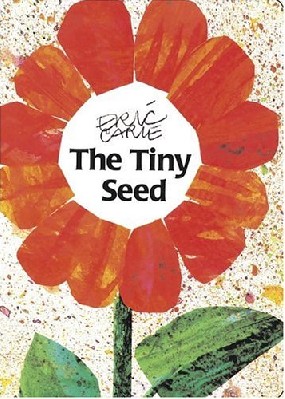
The Tiny Seed 
by Eric Carle
This is a nice story about the life cycle of a seed. One adventurous seed starts out tinier than the others, but in the end grows tallest of all. 

The Apple Pie Tree 
by Zoe Hall, illustrated by Shari Halpern
Two little girls watch the evolution of their family apple tree from bare-branch winter to autumn harvest.

A Promise is a Promise 
by Eve Tharlet
A little marmot becomes best friends with a dandelion, who eventually asks the marmot to blow her seeds to the wind, and trust that everything will be okay. After a lot of worry and a good hibernation, he awakes to a beautiful surprise. 

Anno's Magic Seeds 
by Mitsumasa Anno
A wizard gives Jack two magic seeds. He tells him to eat one and bury the other, promising that it will produce two more in the fall. A mathematical story of the miraculous multiplying and saving potential hidden in every little seed.

Wangari's Trees of Peace 
by Jeanette Winter
After completing her studies abroad, Wangari Maathai returns to her native Kenya to find many of the old forests destroyed. Beginning in her own backyard, she begins planting trees, eventually persuading other women of her town and country to assist in the efforts. They plant 30 million trees. 


Mama Miti 
by Donna Jo Napoli, illustrated by Kadir Nelson
Another take on Wangari, this book shows in dazzling illustration her confident response to the variety of problems coming from women all over Kenya: "Plant a tree!" 

Aside: in 2004 Wangari received the Nobel Peace Prize for her contributions to sustainable development, democracy, and peace. I read her bio on wikipedia and was amazed at her life! There are many earth-lovers who have made similar efforts and sacrifices. You might enjoy learning about:

John Muir
Rachel Carson
Jacques Cousteau
Gaylord Nelson
And many more, I'm sure!

Here are a few more books that are either educational (without a storyline) or compilations of earth-centered activities. You might like:

One Well: the Story of Water on Earth 
by Rochelle Strauss, illustrated by Rosemary Woods
Earth's water supply is essentially one big well. This book talks all about water: the water cycle, our collective need for water, access to water, water pollution, and becoming "well aware."

What's So Special About Planet Earth? 
by Robert E. Wells
This book encourages kids to value our world by taking a look at how it is suited uniquely for us. At the end he shares some ideas for conserving resources and using energy wisely.

Best Kids Love-the-Earth Activity Book 
This is a terrific compilation of ideas for understanding and exploring the earth. Here is just a smattering from this book: design a nature collage, pound a leaf into fabric, make sun tea, make fresh water from salt water, make wind-powered music, make a bird hangout, host a party for the planet, dye earth-friendly easter eggs (which I tried this year, though not from this book), and LOTS of ideas for reusing various materials.

My First Green Book: A Life-Size Guide to Caring for our Environment 
by Angela Wilkes
Though a little old-school, this book has some good stuff. It includes information on an array of subjects ranging from waste disposal to the rain forest and features activities such as testing your own water and soil, making a water filter, creating a wildlife garden, and campaigning for change.

Love Your World: How to Take Care of the Plants, the Animals, and the Planet 
by Dawn Sirett
This was a favorite for my kids. It contains lots of colorful pictures and little poems about loving and caring for the earth, encouraging kids to make a difference!

HAPPY EARTH DAY!!
(You can celebrate Earth Day as long as you want.)

Wednesday, March 5, 2014

Considering Health: Mindful Food Choices

Ariel recently shared a TED talk called "Why Dieting Doesn't Usually Work" by Sandra Aamodt. My response was too long and tangential for the comment box, so I thought I would shape it into a post.

In most cases, weight is not how we should gauge health. Rather, we should look at more accurate indicators such as skin health, teeth health, digestive health, energy levels, alignment, strength, flexibility, and resistance to illness, among others. (What else comes to your mind?) If these things suggest balance and wellness, one's correct weight will probably follow.


When it comes to eating, I am a strong believer in the body's intuition. Not only can our bodies tell us when to eat and when to stop, but which nutrients we are lacking and how we might obtain them. Sometimes we have to get our meddling minds out of the way so as not to miss the prompting. I try hard to model this and teach it to my children. (As a result, they occasionally refer to themselves as "my body" instead of "I" when stating a need, or, for more convincing power with Mama, they'll use the phrase, "my body is telling me..." Funny kids.)

Ms. Aamodt alluded to this in her talk, but I think it should be clearly stated that which foods we eat is of utmost importance (not just when and how much). A body with optimal nutrition is more likely to function optimally. It is equally crucial that we source our food mindfully. Where did the food come from? How was it grown or raised? When buying a packaged product, I am a habitual ingredient-reader, seeking to know what each ingredient is, where it likely came from, and how it might affect my body.


I can't help but share my feelings that the current dietary recommendations in our country are flawed. They are not rooted in the traditions that guided the development of our bodies, nor are they based on solid science (this might be why). They are not pointing the country to glowing health. In fact, we are in an epidemic of obesity, diabetes, heart disease, and cancer (to name a few) that has spiraled out of control under these guidelines. (Food choice is not solely to blame for these problems, but it is significant.)

Following are a few examples of harmful food choices, sanctioned under USDA guidelines, that are contributing to our collective declining health:

Vegetable oils 
Touted as "healthy polyunsaturated fats," these volatile oils become rancid through high-temperature chemical extraction and cooking. As a result, free radicals are formed, causing damage in the body and contributing to a host of serious ailments. They are completely untraditional, never having been accessible until the industrial revolution. Partially-hydrogenated oils are even worse, containing highly toxic trans fats that wreak havoc. (For a thorough discussion on fats, read this article by lipids researcher Mary Enig. To give credit where credit is due, the FDA has acknowledged the serious risk of trans fats.)
  • We do not buy vegetable oil, or anything containing it, specifically: canola, soybean, corn, cottonseed, sunflower, safflower, rice bran, or grape seed. Instead we choose healthy, nourishing fats such as coconut oil, butter, olive oil, lard, and tallow.

Sugar 
Besides being addictive, sugar is the primary culprit of weight gain. It also depresses immune function, disrupts hormones, leads to anxiety and depression, and generally contributes to inflammation. Containing zero nutrition in itself, refined sugar taxes the body's nutrient stores in order to get digested, leading to a deficit. Sugar consumption causes blood sugar imbalance: energy highs followed by intense lows. This is a good overview of the effects of sugar in our every-day lives, and some tips on how to beat it!
  • In our home, we do not buy any type of refined sugar, and use natural sweeteners in moderation. 

Whole grains 
Most people know that refined flour is a nutritional no-no. Unfortunately, even whole grains are taxing on the digestive system unless carefully prepared using traditional methods like fermenting or soaking. Sprouting is also a fine choice. With these pre-digestive preparations in place, several things occur: 1) phytic acid is neutralized, freeing nutrients for assimilation, 2) proteins (like gluten) become more digestible, 3) enzyme inhibitors are also neutralized, allowing beneficial enzymes to increase vitamins in the grain, and 4) and the carb count is reduced, lowering the amount of sugar released into the bloodstream.
  • For these reasons, all the grains we use at home are freshly-ground, then soured or soaked. We also sprout and dry grain regularly so we always have some on hand.

Low-fat dairy
Indigenous cultures thrived on dairy in its whole form without suffering any of the ills prophesied by the low-fat peddlers. We need stable saturated fat for many vital functions: building cell membranes, protecting from toxins and harmful microbes, strengthening immunity, carrying certain vitamins (A, D, K, and E) into cells, assimilating calcium into bones, protecting reproductive health, and certainly building a healthy baby. (I am so tired of seeing recommendations that pregnant women consume low-fat dairy!) Mainstream media sources are starting to recognize the unjust slander against saturated fat.
  • We consume dairy products in their whole form.

Pasteurized, homogenized dairy
Pasteurization kills digestive enzymes that help break down the milk sugar and the probiotic bacteria that contribute to healthy gut flora (and thereby strong immunity). People who have trouble digesting pasteurized milk are often fine on raw milk. Homogenization crushes and damages the fat and cholesterol of the milk. This kind of milk differs from it's raw counterpart at the molecular level.
  • We consume high-quality raw dairy products. (Remember, there are two kinds of raw milk: that intended for human consumption and that intended for pasteurization. Never drink the latter!) If I do have to buy pasteurized dairy, I buy full-fat, cream-top, organic, and grass-fed if possible (and never ultra-pasteurized).

Chemical-ridden food
We have strayed so far from the days of clean food. Claims that the fertilizers, pesticides, antibiotics, and hormones applied so heavily to our food have minimal effects on our bodies are erroneous. It's a mess. Here are ten reasons to eat organic from the Organic Consumers Association.
  • We buy organic dairy, meat, eggs, and produce directly from farmers we trust. If we eat out, we consider paying the extra bucks to patronize restaurants who share our values.


Whole real foods, prepared for optimal digestion and nutrient absorption are a top priority in my home. It takes a huge amount of mindfulness, commitment, and planning to make it happen, but I see—no, I feel—that it is worth the effort a hundredfold. 

It feels welcome. It tastes delicious.

Sunday, November 10, 2013

Menstrual Cup: the solution

My menstrual cycle: officially revolutionized.

Can I share with you one of the greatest discoveries of my life?  This is a TMI post, but don't be embarrassed and stop reading even if you are a guy, because you might want to change your wife's life with this.

I'm into natural living for two reasons.  One, because it's the big fad right now.

Just kidding.  One, because I care about my health.  I want to consume foods and other products that do not introduce any toxins to my body.  (Beyond that, products and foods that nourish my body are highly preferred).  Two, because I care about the earth.  I really care about the earth.  And I realized a couple years ago that my way of living --- the standard American way of living --- was hurtful to the earth.


I have a long way to go in averting hypocrisy on both counts, but I've come a long way.  More on that some other time.

Today lets talk about my reasons for questioning my lifelong use of menstrual pads and tampons.

Even the ones made from "organic cotton."  

Even the ones with "biodegradable applicators."  

Even the "chlorine-free" ones.  

The catalyst to my research was the realization of how much WASTE I was creating every month.  (This book estimates that the average woman throws away up to 300 pounds of feminine hygiene products in a lifetime --- and that doesn't take into consideration the destructive production processes for these products).  But I soon realized there was so much more.

It came down to this: menstrual pads are slightly more destructive to the environment than tampons because of their plastic components.  (See this study done by the Royal Institute of Technology in Stockholm); tampons are more destructive to the body because they simply make more contact with some of the most absorbent tissues in the body, exposing them to dioxins --- yes, even since bleaching processes have been changed to reduce dioxin content.  (See page 22: "Dioxins are known to cause cancer in animals, and probably cause cancer in people.  People exposed to high levels of dioxins may be at risk for a damaged immune system, increased risk of pelvic inflammatory disease, and reduced fertility."  Here's what the EPA has to say about dioxins.)  Both products are also likely to contain BPA or BPS, as most paper products do, as well as phthalates and DEHP.

All this in one of the most sensitive and absorbent areas of the body!  Not to mention that these plastic/paper products restrict air flow, promoting yeast infections and bacterial growth in the vaginal area.  Tampons also absorb not just blood, but all moisture in the vagina, including healthy fluids that are necessary to protect the vaginal walls and maintain the correct pH level and beneficial bacteria populations.

In this article by Dr. Mercola, a few other tampon/pad risks are mentioned:
  • Conventional tampons contain pesticides: A whopping $2 billion is spent annually on pesticides to spray cotton crops.
  • Conventional tampons probably contain genetically-modified organisms (GMOs). According the USDA, 94 percent of all U.S. cotton is genetically engineered.  
  • Tampons and pads with odor neutralizers and artificial fragrances are virtually a chemical soup, laced with artificial colors, polyester, adhesives, polyethylene (PET), polypropylene and propylene glycol (PEG), contaminants linked to hormone disruption, cancer, birth defects, dryness and infertility.
Finally, tampons have been known to cause Toxic Shock Syndrome on occasion, due to build-up of bacteria growth.  TSS is a life-threatening condition, and while it is rare for women to incur it from tampon-use, it is a noted risk.


So What On Earth Am I Supposed to USE?!

Rags, right?  You want me to use rags like the pioneer ladies.

Sure, use rags.

It may alter your gait for one week of the month, and increase your laundry pile a bit, and use a bit more water for cleaning, but rags are a great option.  Lots of people use homemade menstrual pads and love it.

But I use a menstrual cup.

Source
I ordered one, 2.5 years ago, and before I got the chance to try it, I was pregnant.  I gave it away --- since you need a bigger size after vaginal birth --- and a few months ago I finally ordered a new one.  Best buy of the year, maybe the decade!

Yes, it just fits right inside.  It catches the blood.  Then you remove it, dump, rinse, and replace.

Mine is a Diva Cup, although there are lots of brands out there.  Here is a forum for people to compare and discuss brands and trouble-shooting that might be useful to you.  (See?  I'm not the only one.)  Keep in mind that you will need a larger size if you have given birth vaginally.

You fold and insert, and give it a full turn so it opens up and suctions to the vaginal wall. Source.
These are the reasons I LOVE my menstrual cup:
  • No waste.  This thing will last for years, and I will not need to throw away a pad or tampon (or its packaging) ever again. 
  • This also means I'll be saving a lot of $$ on hygiene products.  It's a one-time purchase of $30 or so.
  • No paper or plastic.  Made of medical-grade silicone (non-latex).  Goodbye dioxins, phthalates, BPA, etc. etc. etc. etc.
  • You only have to change it every 8-12 hours, depending on how heavy your cycle is.
  • NO LEAKING.  Mine only leaked once the first cycle I used it, and that was because I left it in (overnight) longer than 12 hours, and it overflowed.  So it leaked just a tiny bit onto the panty liner I was wearing as an extra precaution.
  • It is completely comfortable: I don't even know it's there.
  • I went camping during a cycle, and didn't have to pack a whole bag of STUFF.  I just used my cup.  Thankfully we were car-camping this trip and there was a sink I could use for rinsing, but I think it would be just fine backpacking too.  You could use a water bottle for rinsing --- away from the camp so as not to attract bears.
  • Rinsing the cup is easy.  If you are in a public place and don't have access to a sink in your stall, you can put it back in as is and rinse when you get home.  Since you don't have to dump it more than every 8-12 hours, probably you won't need to rinse it while you are away from home much.
  • A lot of people say that it takes some getting used to, some trial and error.  Mine worked perfectly the first time.
  • It has been enlightening to know visually how much I actually bleed during a period.  As someone who charts, this data is somehow interesting to me.
  • While reusable cloth pads are great, this allows for freedom of movement (and swimming, etc.) the way a tampon does. 
  • It comes with a cute little bag for storage.  I put it in my purse when I know my period will be starting that day.  (I always know because I chart my temperatures).

A menstrual cup might not be for everyone... maybe.  

But for now, it is the only thing for me.  I know I won't be going back.

Wednesday, October 23, 2013

GMO Labeling: An Update and a Plea

A year ago this week, I did a post on California's Prop 37, aimed at requiring the labeling of genetically-modified organisms in our food. Narrowly, the proposition failed, thanks to a ruthless ad campaign by the opposition, who collectively donated $46 million to confuse voters and ensure its defeat. I was sad about all the misinformation that was propagated during that time.

Since then, MaineConnecticut, and Vermont have passed labeling laws, joining 64 other countries around the world.


Now the state of Washington is fighting the good fight for GMO labeling with ballot initiative 522, coming up for vote next month. As with Prop 37, recent polls show that the gap between Yes and No voters is narrowing, due again to an influx of advertising cash from the opposition.

Right now, Dr. Bronner's and Nutiva are TRIPLING donations made to FoodDemocracyNow! on behalf of I-522. Will you contribute to this cause? Even just $5.22? If you can't afford to donate but still want to help, now is a great time to make calls to voters to help educate them on this issue.

Truth be told, I am generally in favor of less regulation, not more. And there are other ways to make it happen. The Non-GMO Project is a good start. Whole Foods Market is requiring labeling in their stores by 2018. Other stores and companies are refusing to include GMOs in their products as well. I couldn't applaud them more loudly! But allowing states to legislate on this issue resonates with my strong desire to stand up to the wealthy food bullies, who, in my opinion, are good stewards of neither earth nor body.

A win in Washington is a win for all of us. So I just donated what I could. Will you?

Sunday, September 29, 2013

Knowing Our Food

My husband and I --- city-dwellers --- own a cow.  
Okay, these are Irish cows we met in July.  But aren't they pretty?
Because the sale of raw milk is illegal in Virginia, we bought a share in a local farmer's herd.  We pay for boarding and milking (instead of for the milk itself which is ours by right of owning the cow), along with other families who own herd shares.  This week we learned that our cow, Buttercream, was being a little fussy.  Our farmer's supplier of organic alfalfa (which they give the cow during milking) had changed the packaging a little, making the alfalfa pellets harder than usual.  In protest, Buttercream stubbornly decided to hold back her milk in one quarter.
Look at the cream content in last week's milk!  (Hint: look at the very bottom of the jar.)  This is a half gallon.
 Poor girl, she developed mastitis in that quarter!  This meant our farmer had to slow milk production to treat her for a weekend.
Now I've had mastitis before, and believe me I feel for Buttercream --- even if she did bring it on herself.  So we have been praying for her to recover quickly in our family prayers.  We also want her to recover because we need her raw milk (and yoghurt and butter)!  Without it, we have learned from experience, we are much more susceptible to whatever is "going around."

My boy helping himself (and his bib) to some creamy raw milk.
This experience has been revealing to me!  Knowing Buttercream, knowing her caretakers, has placed us in a position where we can:
  • Be in touch with where our food is coming from --- personally in touch
  • Help out where we can (in this case through prayer)
  • Experience vulnerability when our food source is threatened, the way almost all of our ancestors have throughout time, and the way many others throughout the world do today.  This is a natural part of the human experience.
Buttercream
 We started drinking raw milk and seeking out other local, truly natural foods for health and environmental reasons.  But I didn't foresee many of the other benefits!  I'll list a few here:
  • As I said above, we know exactly what is going on in the production of our food.  I know the details of how Buttercream is being treated for her mastitis, and how her caretakers treat her in general.  She is well-loved, and that makes me feel good about paying for her (dreamy creamy) milk.  I mean...er...paying for the labor of boarding and milking her.
  • We know the farmers who raise our meat and eggs as well.  Those whose farms I haven't visited, I will visit soon.  Knowing these farmers, and having met many of these animals, I feel more thankful for the meat placed on our table.  When we bless meals containing meat, I thank the Lord for the animal who gave its life, and feel genuine gratitude in my heart.  Our food is now personal.
  • We also are learning many new things by getting local, humanely raised food.  I am learning when certain fruits and vegetables are in season --- things I didn't always know growing up because we can always get anything year round from the supermarket.
  • I am also learning that things naturally taste different in different seasons.  For instance, Buttercream's milk was sweeter in August than it is now, since she is eating fall grass which has a more bitter taste.  (Cam has a hard time getting this autumn milk down, because of the bitterness).  Did you know milk and its derivatives will likely taste different depending on the season?  Real orange juice too.
Last week's farmers' market yield, all organic: mixed greens, zucchini, bell peppers, green beans, white turnips, pastured eggs, grass-fed beef and liver
I love what I am learning as I understand, and as I am personally acquainted with, the sources of our food.  I love the feeling of solidarity with the farmers who work so hard to produce healthy foods sustainably and with integrity.  I love our new connection to the earth's cycles.  Good health and happiness are the promises of full, rich nutrition.  But knowledge, gratitude, and perhaps a little wisdom, come with it as well.