Pages

Showing posts with label Homeschooling. Show all posts

Monday, April 21, 2014

Children's Books for Loving the Earth

Over the months, we have discovered a number of children's books (mostly from the library) that have enhanced our love for the earth and our determination to take good care of it. Here are some of our favorites, just in time for Earth Day tomorrow.

Please share the books you and your kids love!

Uno's Garden 
by Graeme Base
Uno watches his beloved forest home slowly transform into a booming metropolis. As the populous grows, the unique indigenous creatures decline. What can be done to save them? Filled with imaginative beauty typical of Graeme Base, this book is also full of fun arithmetic and a wonderful message about the importance of keeping balance with nature.


The Barefoot Book of Earth Tales 
by Dawn Casey and Anne Wilson
This is a beautiful collection of tales from seven diverse countries. The colorful, captivating writing brought me to the edge of tears several times, but my little boys loved them, too! Along with each story is an activity relating in some way to the culture (e.g. make a cornhusk doll, build a willow den, make a mini water garden).


Earth Mother 
by Ellen Jackson, illustrated by Leo and Diane Dillon
In this light-hearted story, Earth Mother goes about ornamenting and caring for the earth in beautiful dress. During her travels, she receives both the thanks and complaints of a toiling man, a frog, and a mosquito, all of whom have insights to gain about the circle of life.


A River Ran Wild 
by Lynne Cherry
This book chronicles the history of the Nashua River in Massachusetts, from the first native settlers to the industrial revolution, which saw factories crop up along it's banks, filling the river with toxic waste. One woman spearheaded a great effort to return the river to its pristine state. (
Incidentally, we recently finished reading the original Boxcar Children books, and one of the books, "Bus Station Mystery," told a very similar story, but without any proper names. It was written around the time of the big cleanup and in the same part of the country, so maybe the Nashua inspired her, too.)

All the Water in the World 
by George Ella Lyon and Katherine Tillotson
A lovely, lyrical presentation of the water cycle.


Brother Sun, Sister Moon: Saint Francis of Assisi's Canticle of the Creatures
by Katherine Paterson, illustrated by Pamela Dalton
Illustrated with watercolored papercuttings, this version of St. Francis of Assisi's famous prayer lends a sweet and strong reminder that God loves his creations and we should, too! 

The Curious Garden 
by Peter Brown
Growing up in a city with no plant life, a young boy discovers some dying plants growing along an abandoned railroad track, and decides to take care of them. As his plants begin to spread, so does his passion to cultivate.

City Green 
by DyAnne DiSalvo-Ryan
A little girl inspires her neighbors to join with her in transforming the old, city-owned, junk-filled lot next to her apartment building into a thriving garden. Besides changing the ugly lot, their efforts also change a heart or two.

Secrets of the Garden: Food Chains and the Food Web in Our Backyard 
by Kathleen Weidner Zoehfeld, illustrated by Priscilla Lamont
This was a fun read about the ins and outs of raising a family garden, including planning, planting, composting, handling pests, and preserving the bounty. Lots of extra information (provided by chickens) includes a helpful discussion on the food web.

Market Day 
by Lois Ehlert
One farmer family takes a day trip to sell their produce at the market. The illustrations are compilations of folk art from all over the world. 

To Market, to Market 
by Nikki McClure
From the perspective of a boy attending attending his local farmer's market with his family, we meet many of the market vendors and learn about the efforts they make to produce their wares.

Brother Eagle Sister Sky 
by Susan Jeffers
Though the origin of this book is controversial (purportedly from a speech by American Indian Chief Seattle), the message about respecting the interconnected web of life is a good one! 


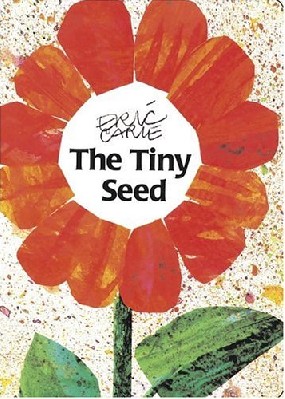
The Tiny Seed 
by Eric Carle
This is a nice story about the life cycle of a seed. One adventurous seed starts out tinier than the others, but in the end grows tallest of all. 

The Apple Pie Tree 
by Zoe Hall, illustrated by Shari Halpern
Two little girls watch the evolution of their family apple tree from bare-branch winter to autumn harvest.

A Promise is a Promise 
by Eve Tharlet
A little marmot becomes best friends with a dandelion, who eventually asks the marmot to blow her seeds to the wind, and trust that everything will be okay. After a lot of worry and a good hibernation, he awakes to a beautiful surprise. 

Anno's Magic Seeds 
by Mitsumasa Anno
A wizard gives Jack two magic seeds. He tells him to eat one and bury the other, promising that it will produce two more in the fall. A mathematical story of the miraculous multiplying and saving potential hidden in every little seed.

Wangari's Trees of Peace 
by Jeanette Winter
After completing her studies abroad, Wangari Maathai returns to her native Kenya to find many of the old forests destroyed. Beginning in her own backyard, she begins planting trees, eventually persuading other women of her town and country to assist in the efforts. They plant 30 million trees. 


Mama Miti 
by Donna Jo Napoli, illustrated by Kadir Nelson
Another take on Wangari, this book shows in dazzling illustration her confident response to the variety of problems coming from women all over Kenya: "Plant a tree!" 

Aside: in 2004 Wangari received the Nobel Peace Prize for her contributions to sustainable development, democracy, and peace. I read her bio on wikipedia and was amazed at her life! There are many earth-lovers who have made similar efforts and sacrifices. You might enjoy learning about:

John Muir
Rachel Carson
Jacques Cousteau
Gaylord Nelson
And many more, I'm sure!

Here are a few more books that are either educational (without a storyline) or compilations of earth-centered activities. You might like:

One Well: the Story of Water on Earth 
by Rochelle Strauss, illustrated by Rosemary Woods
Earth's water supply is essentially one big well. This book talks all about water: the water cycle, our collective need for water, access to water, water pollution, and becoming "well aware."

What's So Special About Planet Earth? 
by Robert E. Wells
This book encourages kids to value our world by taking a look at how it is suited uniquely for us. At the end he shares some ideas for conserving resources and using energy wisely.

Best Kids Love-the-Earth Activity Book 
This is a terrific compilation of ideas for understanding and exploring the earth. Here is just a smattering from this book: design a nature collage, pound a leaf into fabric, make sun tea, make fresh water from salt water, make wind-powered music, make a bird hangout, host a party for the planet, dye earth-friendly easter eggs (which I tried this year, though not from this book), and LOTS of ideas for reusing various materials.

My First Green Book: A Life-Size Guide to Caring for our Environment 
by Angela Wilkes
Though a little old-school, this book has some good stuff. It includes information on an array of subjects ranging from waste disposal to the rain forest and features activities such as testing your own water and soil, making a water filter, creating a wildlife garden, and campaigning for change.

Love Your World: How to Take Care of the Plants, the Animals, and the Planet 
by Dawn Sirett
This was a favorite for my kids. It contains lots of colorful pictures and little poems about loving and caring for the earth, encouraging kids to make a difference!

HAPPY EARTH DAY!!
(You can celebrate Earth Day as long as you want.)

Tuesday, November 20, 2012

Live in Thanksgiving Daily

For me, Thanksgiving is the warmest time of the year, surpassing even Christmas by its lack of consumerism. It's so much more than a feast. It's a unique time to express gratitude for our blessings. A welcome reminder to "live in thanksgiving daily" (Alma 34:38).

The Lord has blessed me abundantly. Myriad little things aside, I am grateful for my family, for my knowledge of the gospel, for motherhood, for my friends, for my health, for my heritage, for freedom, for our means, for access to good food, for my love affair with great music, and can I say, for my red hair? (Never understood Anne Shirley's laments.) I could go on and on.

My children are my greatest treasures. 

One of my husband's spiritual gifts is a grateful heart. He feels it genuinely and deeply, expresses it often, and expects our boys to learn to do the same. Here are some things we have done to instill this chief virtue in our children:
  • We try to be examples by saying thank you often, both to each other and to them. 
  • We coach them in thanking Heavenly Father specifically during prayer. 
  • We try to speak gratefully of good deeds done by others. 
  • We give gentle reminders if the boys forget to thank, but more and more, they don't forget. 
  • We've recently started a tradition of each saying one thing we're grateful for before family prayer. It's a great way to bring peace to the evening.


Thanksgiving is a fun time to count our numberless blessings. Last year, Sammy and I started taping blessings on the living room wall during home preschool we do with a friend, and continued to add ideas throughout the month.

.

This year, we made a turkey with a blessing on every tail feather. Instead of asking, "What are you grateful for?" I asked, "What has Heavenly Father given you to make your life good?"


As I have made efforts to become more grateful over the years, I have noticed heavenly results. Gratitude is unifying. It is healing. It is humbling and strengthening. It enhances one's quality of life. Not to mention...

"And he who receiveth all things with thankfulness shall be made glorious; and the things of this earth shall be added unto him, even an hundred fold, yea, more" (D&C 78:19).

What are you exceedingly grateful for?
How do you teach gratitude to your children?

Happy Thanksgiving!

Monday, June 25, 2012

Classical Education: Birth to Three

Last week, I posted a brief intro on classical education according to The Well-Trained Mind: A Guide to Classical Education at Home by Susan Wise Bauer and Jessie Wise. Since we (the blog authors) all have very young kids, I'd like to summarize their recommendations for the first three years (pp. 27-30). Perhaps I'll do another follow-up with their advice for 4-5-year-old preschoolers.

"When you educate your child at home, you don't have to draw a line between parenting and teaching" (p. 26). The bottom line is to immerse your child in language from birth, though the authors share specific ideas for preparing children to learn reading, writing, and math.

Reading Preparation: "Prereading preparation works. Susan [the coauthor daughter] was reading on a fifth-grade level in kindergarten... If you create a language-rich home, limit TV and videos, and then teach systematic phonics, you will produce readers."
  • TALK: Talk constantly. Explain what you're doing and why. "This sort of constant chatter lays a verbal foundation in your child's mind. She's learning that words are used to plan, to think, to explain; she's figuring out how the English language organizes words into phrases, clauses, and complete sentences."
  • READ: Read all the time. Start with sturdy books ("a torn book or two is a small price to pay for literacy"). Read picture books, pointing to the words with your finger, then read them again and again. "Repetition builds literacy." Read longer books out loud with baby playing nearby. 
    • After reading together, ask your child questions about the story. "What did the gingerbread boy do when the old woman tried to eat him? When the dog got to the top of the tree at the end of Go, Dog, Go, what did they find? What happened after Bananas Gorilla stole all the bananas?"
    • Record yourself reading, singing, reciting, and telling stories for the child to listen over and over.
      • To this day, I remember the bedtime tape that my parents made for us to listen to as we fell asleep. I can quote those stories and poems with the same inflections that my parents told them (Mom's Puffin, Put a Poem in Your Pocket, Frog and Toad stories, Dad doing all sorts of A.A. Milne poems...).
  • ALPHABET: Teach your child the alphabet as soon as she starts speaking. Sing the alphabet song, read alphabet books, put the letters up on the wall. Teach her the sounds of the letters just as you teach the sounds of the animals. "Pigs say oink; dogs say woof; B says b, b, b.
    • Start with the sounds of the consonants. "Tell her that b is the sound at the beginning of bat, ball, and Ben; say, 'T, t, tickle' and 'M, m, mommy' and 'C, c, cat.'"
    • "Then tell her that the vowels are named A, E, I, O, and U. Sing, 'Old McDonald had a farm, A, E, I, O, U.'" Emphasize that each vowel has a sound just as each animal makes a sound, and teach only the short sounds of the vowels at first: "A as in at," "E as in egg," etc.

Writing Preparation: "Continual drawing and making counterclockwise circles will prepare the preschooler for kindergarten writing."
  • Teach your child to hold the pencil correctly from the beginning. Draw lots of circles and loops in a counterclockwise direction, as most printed letters use counterclockwise circles. "Make snowmen, Slinkies, smoke from a train, car wheels, and so forth counterclockwise."
  • Before a young child can hold a pencil, let her form numbers, letters, and circles without one. If she wants to use one, "she can use chalk on a big chalkboard or a crayon or pencil on large sheets of paper. Regular-diameter short pencils are often easier for small fingers than fat 'preschool' pencils."
  • Create basic dot-to-dots for your three-year-old (a house, a smiley face) using several big dots. Then guide the child's crayon from one dot to another to see the picture emerge.

Math Preparation: "Start to make your child 'mathematically literate' in the toddler years. Just as you read to the toddler, surrounding her with language until she understood that printed words on a page carried meaning, you need to expose her to mathematical processes and language continually. Only then will she understand that mathematical symbols carry meaning."
  • Make numbers a part of everyday life. "Start with counting: fingers, toes, eyes, and ears; toys and treasures; rocks and sticks. Play hide-and-seek, counting to five and then to ten, fifteen, or twenty together. Count by twos, fives, and tens before shouting, 'Coming, ready or not!' Play spaceship in cardboard boxes, and count backward to takeoff."
    • Each night, we count with Daniel before turning off the lamp. We started by counting to three, and eventually he started saying it himself. So we gradually added numbers, and now at 21 months, he can count to ten by himself! Maybe that's not unusual, I'm just constantly impressed by how these little guys can learn.
  • Read number books together.
  • Once the child is comfortable counting, start working on simple math sums (usually during the K-4 and K-5 years).

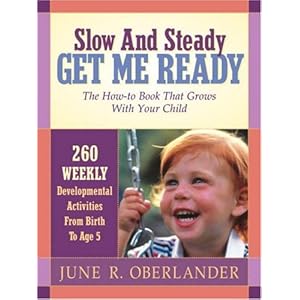
As a general preschool learning resource, the authors recommend June R. Oberlander's Slow and Steady, Get Me Ready, "a birth-to-age-5 activity book that provides a new, developmentally appropriate activity for each week of life. Week 1 begins with exercising the newborn's arms and legs; age 5, week 52, ends with learning to pack an overnight bag. In between, Oberlander (a kindergarten teacher) covers everything from playing peekaboo and learning "in" and "out" through tying shoes, memorizing telephone numbers, bouncing balls, and singing the alphabet while making a different body movement for each letter. It's a complete preschool in one volume. You may not feel you need this resource, but by combining the prereading instruction of the Oberlander book with lots of active play, you'll have the at-home equivalent of an excellent preschool program."
  • I found an online pdf of this book here if you'd like to peruse.

You'll probably be pleased to see that you do some of this preschooling naturally at your house, but if you're an idea-stealer like me, you're always happy for some good ones!

Got more to share?

Thursday, June 21, 2012

A Classical Education at Home

We are leaning toward homeschooling our kids, though it's daunting to consider. What do I do? What do I teach? How do I learn it all? What's the best way? There are countless philosophies, ranging from one extreme to the other with everything in between. I've barely scratched the surface in discovering my options, let alone exploring them. Fortunately, the whole idea of homeschooling allows for endless flexibility.

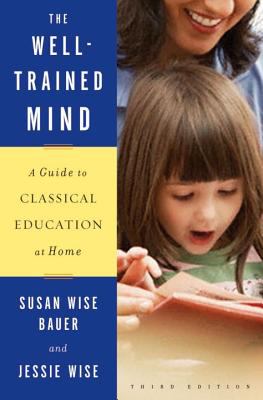
For my birthday last month, Keenan gave me a resource I've been curious about: The Well-Trained Mind: A Guide to Classical Education at Home by mother-daughter duo Susan Wise Bauer and Jessie Wise. I was impressed at the biographical merits of these women. Their experience and education more than qualify them as guides for parents who are eager to give their children a classical education at home.


What is Classical Education?
If you're like me, you're not sure exactly what is meant by "classical education." This post provides but a scant overview, based on what I've read so far. Here is a snippet from the Introduction (p. xxii):
What is a classical education?
It is language-intensive -- not image-focused. It demands that students use and understand words, not video images.
It is history-intensive, providing students with a comprehensive view of human endeavor from the beginning until now.
It trains the mind to analyze and draw conclusions.
It demands self-discipline.
It produces literate, curious, intelligent students who have a wide range of interests and the ability to follow up on them.
The Well-Trained Mind is a handbook on how to prepare your child to read, write, calculate, think, and understand.
How is the Curriculum Structured?
This book is a textbook in itself. It "provides information on teaching all the subjects in the classical curriculum for all twelve grades -- literature, writing, grammar, history, science, math, Latin, modern languages, art, music, debate, and more" (p. xxv).

The structure is based around a three-part process to training the mind, called the classical pattern of the trivium (from pp. 13-14, a bit reworded):
  1. The "grammar stage" (grades 1-4) prepares the mind to absorb information through memorization of facts: rules of phonics and spelling, rules of grammar, poems, the vocabulary of foreign languages, the stories of history and literature, descriptions of plants and animals and the human body, the facts of mathematics, etc.
  2. The "logic stage" (grades 5-8) builds on the facts absorbed in the first phase. It is a time when the child begins to pay attention to cause and effect, to the relationships among different fields of knowledge, to the way facts fit together into a logical framework. At this age, the mind naturally begins to think more analytically. A student is ready for the logic stage when the capacity for abstract thought begins to mature. During this time, the student learns algebra and logic, and begins to apply logic to all academic subjects.
  3. The "rhetoric stage" (grades 9-12) is the final phase of a classical education, and builds on the first two. At this point, the high-school student learns to write and speak with force and originality. The student of rhetoric applies the rules of logic learned in middle school to the foundational information learned in the early grades and expresses conclusions in clear, forceful, elegant language. The student also begins to specialize in whatever branch of knowledge attracts her; these are the years for art camps, college courses, foreign travel, apprenticeships, and other forms of specialized training.
I find it interesting how the system is centered around history: "To the classical mind, all knowledge is interrelated... A classical education [takes] history as its organizing outline, beginning with the ancients and progressing forward to the moderns in history, science, literature, art, and music" (pp. 14-15). The authors recommend that the twelve years of education consist of three repetitions of the same four-year pattern: the ancients (5000 B.C. - A.D. 400), the medieval period through the early Renaissance (400-1600), the late Renaissance through early modern times (1600-1850), and modern times (1850-present). "The child studies these four time periods at varying levels -- simple for grades 1 through 4, more difficult in grades 5 through 8... and taking an even more complex approach in grades 9-12." I was fascinated by the descriptions and examples of how the other areas of the curriculum are linked to history studies, but this post is already too long to share!

Children Can Do Hard Things
The authors emphasize that the benefits of this education are not exclusively academic:
Rigorous study develops virtue in the student: the ability to act in accordance to what one knows to be right. Virtuous men (or women) can force themselves to do what they know is right, even when it runs against their inclinations. Classical education continually asks a student to work against her baser tendencies... in order to reach a goal -- mastery of a subject (p. 17). 
As a Suzuki violin teacher who requires daily practice from my students, these words couldn't ring truer. Yes, working daily at something difficult but worthwhile gives a student proficiency, but even more valuable are the dozens of life skills absorbed throughout the process.

Still Daunted?
I am. Truth be told, this book hasn't helped the intimidated parent factor much. But the authors insist that any parent can succeed.
All you need to teach your child at home is dedication, some basic knowledge about how children learn, guidance in teaching the particular skills of each academic subject, and lots of books, tapes, posters, kits, and other resources. This book will provide you with everything except the dedication (p. xxii). 
Maybe I can muster that. ;) I don't know yet if classical education is a match for my family, but it's been interesting to study. In fact...

STAY TUNED!
The first item that popped out at me from the Table of Contents was the little section called Preschool: Birth to Three. This is what I originally intended to blog about today, but as I got going, it seemed a basic introduction was necessary. You can watch for that post next week.

Do you know any homeschoolers who follow a classical education? Please share your thoughts!