Pages

Showing posts with label Causes. Show all posts

Tuesday, April 29, 2014

The Soggy Lettuce Conundrum (and How to Stop It)

Sometimes I lose produce before I can use it.

Well, it actually happens less often since I stuck this nifty sticky whiteboard to my fridge. Now I write down all our produce and perishable leftovers so I remember what's going on in my kitchen (both in and out of the fridge).

I took this photo back in January (probably after a CSA box 
or a trip to the Farmer's Market since there's so much on there).

I have always hated losing produce. It's such a waste, not only of the food itself, but of everything it took to grow that food.

I recently watched this TED talk by Leyla Acaroglu called Paper beats plastic? How to rethink environmental folklore. I think all 18 minutes are worthwhile. I've watched it twice.


Toward the beginning of the talk, Acaroglu points out that biodegradability is "a material property, not a definition of environmental benefit." That got me slowly nodding my head. She went on:
When something natural [like food waste or paper] ends up in the natural environment, it degrades normally. Its little carbon molecules that it's stored up as it was growing are naturally released back into the atmosphere as carbon dioxide. But this is a net situation. Most natural things don't actually end up in nature. Most of the waste that we produce ends up in landfill. Landfill is a different environment. In landfill, those same carbon molecules degrade in a different way because a landfill is anaerobic. It's got no oxygen. It's tightly compacted and hot. Those same molecules, they become methane, and methane is a 25x more potent greenhouse gas than carbon dioxide. So our old lettuces and products that we have thrown out that are made out of biodegradable materials, if they end up in landfill, contribute to climate change.
Whoa, what? When I throw the soggy lettuce in the trash, it's destiny is methane? When I toss a piece of paper in the trash, it's destiny is probably methane?? Why did this never occur to me?

Realizing this actually made me glad about two things.

First, that we compost, which means that this:


turns into this:


We use it to enrich the soil and feed the earthworms. :)

However, when the compost tumbler is a-tumbling, I don't add anything to it for several weeks (which is why having two would be awesome). So, second, when I can't add my biodegradables to the composter, I typically toss them behind these lovely bushes in the front yard. 


Here's a close-up:


When I started doing this over a year ago, I figured that even though I couldn't use the compost how I'd like, I was still feeding the earth. Something beautiful will grow there some day.

I'm happy to have another way to care for the earth in my arsenal, and a good reason for doing so!

If composting isn't an option for you at the moment, is there somewhere else you can toss those kitchen scraps so they don't wind up in a landfill? If you don't have a yard, you could always add your scraps to broth or soups to get more life out of them. I bought an eBook bundle once that included one called Don't Compost It, Cook It. I haven't read it thoroughly, but the the author has some good ideas for getting as much mileage as possible out of your food.

How do you avoid losing produce? How do you make use of any peelings and trimmings?

Monday, April 21, 2014

Children's Books for Loving the Earth

Over the months, we have discovered a number of children's books (mostly from the library) that have enhanced our love for the earth and our determination to take good care of it. Here are some of our favorites, just in time for Earth Day tomorrow.

Please share the books you and your kids love!

Uno's Garden 
by Graeme Base
Uno watches his beloved forest home slowly transform into a booming metropolis. As the populous grows, the unique indigenous creatures decline. What can be done to save them? Filled with imaginative beauty typical of Graeme Base, this book is also full of fun arithmetic and a wonderful message about the importance of keeping balance with nature.


The Barefoot Book of Earth Tales 
by Dawn Casey and Anne Wilson
This is a beautiful collection of tales from seven diverse countries. The colorful, captivating writing brought me to the edge of tears several times, but my little boys loved them, too! Along with each story is an activity relating in some way to the culture (e.g. make a cornhusk doll, build a willow den, make a mini water garden).


Earth Mother 
by Ellen Jackson, illustrated by Leo and Diane Dillon
In this light-hearted story, Earth Mother goes about ornamenting and caring for the earth in beautiful dress. During her travels, she receives both the thanks and complaints of a toiling man, a frog, and a mosquito, all of whom have insights to gain about the circle of life.


A River Ran Wild 
by Lynne Cherry
This book chronicles the history of the Nashua River in Massachusetts, from the first native settlers to the industrial revolution, which saw factories crop up along it's banks, filling the river with toxic waste. One woman spearheaded a great effort to return the river to its pristine state. (
Incidentally, we recently finished reading the original Boxcar Children books, and one of the books, "Bus Station Mystery," told a very similar story, but without any proper names. It was written around the time of the big cleanup and in the same part of the country, so maybe the Nashua inspired her, too.)

All the Water in the World 
by George Ella Lyon and Katherine Tillotson
A lovely, lyrical presentation of the water cycle.


Brother Sun, Sister Moon: Saint Francis of Assisi's Canticle of the Creatures
by Katherine Paterson, illustrated by Pamela Dalton
Illustrated with watercolored papercuttings, this version of St. Francis of Assisi's famous prayer lends a sweet and strong reminder that God loves his creations and we should, too! 

The Curious Garden 
by Peter Brown
Growing up in a city with no plant life, a young boy discovers some dying plants growing along an abandoned railroad track, and decides to take care of them. As his plants begin to spread, so does his passion to cultivate.

City Green 
by DyAnne DiSalvo-Ryan
A little girl inspires her neighbors to join with her in transforming the old, city-owned, junk-filled lot next to her apartment building into a thriving garden. Besides changing the ugly lot, their efforts also change a heart or two.

Secrets of the Garden: Food Chains and the Food Web in Our Backyard 
by Kathleen Weidner Zoehfeld, illustrated by Priscilla Lamont
This was a fun read about the ins and outs of raising a family garden, including planning, planting, composting, handling pests, and preserving the bounty. Lots of extra information (provided by chickens) includes a helpful discussion on the food web.

Market Day 
by Lois Ehlert
One farmer family takes a day trip to sell their produce at the market. The illustrations are compilations of folk art from all over the world. 

To Market, to Market 
by Nikki McClure
From the perspective of a boy attending attending his local farmer's market with his family, we meet many of the market vendors and learn about the efforts they make to produce their wares.

Brother Eagle Sister Sky 
by Susan Jeffers
Though the origin of this book is controversial (purportedly from a speech by American Indian Chief Seattle), the message about respecting the interconnected web of life is a good one! 


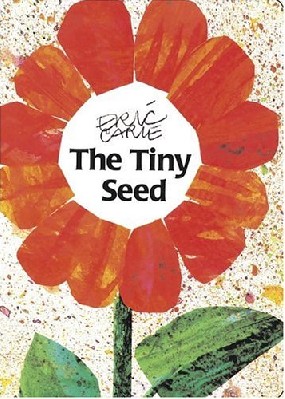
The Tiny Seed 
by Eric Carle
This is a nice story about the life cycle of a seed. One adventurous seed starts out tinier than the others, but in the end grows tallest of all. 

The Apple Pie Tree 
by Zoe Hall, illustrated by Shari Halpern
Two little girls watch the evolution of their family apple tree from bare-branch winter to autumn harvest.

A Promise is a Promise 
by Eve Tharlet
A little marmot becomes best friends with a dandelion, who eventually asks the marmot to blow her seeds to the wind, and trust that everything will be okay. After a lot of worry and a good hibernation, he awakes to a beautiful surprise. 

Anno's Magic Seeds 
by Mitsumasa Anno
A wizard gives Jack two magic seeds. He tells him to eat one and bury the other, promising that it will produce two more in the fall. A mathematical story of the miraculous multiplying and saving potential hidden in every little seed.

Wangari's Trees of Peace 
by Jeanette Winter
After completing her studies abroad, Wangari Maathai returns to her native Kenya to find many of the old forests destroyed. Beginning in her own backyard, she begins planting trees, eventually persuading other women of her town and country to assist in the efforts. They plant 30 million trees. 


Mama Miti 
by Donna Jo Napoli, illustrated by Kadir Nelson
Another take on Wangari, this book shows in dazzling illustration her confident response to the variety of problems coming from women all over Kenya: "Plant a tree!" 

Aside: in 2004 Wangari received the Nobel Peace Prize for her contributions to sustainable development, democracy, and peace. I read her bio on wikipedia and was amazed at her life! There are many earth-lovers who have made similar efforts and sacrifices. You might enjoy learning about:

John Muir
Rachel Carson
Jacques Cousteau
Gaylord Nelson
And many more, I'm sure!

Here are a few more books that are either educational (without a storyline) or compilations of earth-centered activities. You might like:

One Well: the Story of Water on Earth 
by Rochelle Strauss, illustrated by Rosemary Woods
Earth's water supply is essentially one big well. This book talks all about water: the water cycle, our collective need for water, access to water, water pollution, and becoming "well aware."

What's So Special About Planet Earth? 
by Robert E. Wells
This book encourages kids to value our world by taking a look at how it is suited uniquely for us. At the end he shares some ideas for conserving resources and using energy wisely.

Best Kids Love-the-Earth Activity Book 
This is a terrific compilation of ideas for understanding and exploring the earth. Here is just a smattering from this book: design a nature collage, pound a leaf into fabric, make sun tea, make fresh water from salt water, make wind-powered music, make a bird hangout, host a party for the planet, dye earth-friendly easter eggs (which I tried this year, though not from this book), and LOTS of ideas for reusing various materials.

My First Green Book: A Life-Size Guide to Caring for our Environment 
by Angela Wilkes
Though a little old-school, this book has some good stuff. It includes information on an array of subjects ranging from waste disposal to the rain forest and features activities such as testing your own water and soil, making a water filter, creating a wildlife garden, and campaigning for change.

Love Your World: How to Take Care of the Plants, the Animals, and the Planet 
by Dawn Sirett
This was a favorite for my kids. It contains lots of colorful pictures and little poems about loving and caring for the earth, encouraging kids to make a difference!

HAPPY EARTH DAY!!
(You can celebrate Earth Day as long as you want.)

Wednesday, October 23, 2013

GMO Labeling: An Update and a Plea

A year ago this week, I did a post on California's Prop 37, aimed at requiring the labeling of genetically-modified organisms in our food. Narrowly, the proposition failed, thanks to a ruthless ad campaign by the opposition, who collectively donated $46 million to confuse voters and ensure its defeat. I was sad about all the misinformation that was propagated during that time.

Since then, MaineConnecticut, and Vermont have passed labeling laws, joining 64 other countries around the world.


Now the state of Washington is fighting the good fight for GMO labeling with ballot initiative 522, coming up for vote next month. As with Prop 37, recent polls show that the gap between Yes and No voters is narrowing, due again to an influx of advertising cash from the opposition.

Right now, Dr. Bronner's and Nutiva are TRIPLING donations made to FoodDemocracyNow! on behalf of I-522. Will you contribute to this cause? Even just $5.22? If you can't afford to donate but still want to help, now is a great time to make calls to voters to help educate them on this issue.

Truth be told, I am generally in favor of less regulation, not more. And there are other ways to make it happen. The Non-GMO Project is a good start. Whole Foods Market is requiring labeling in their stores by 2018. Other stores and companies are refusing to include GMOs in their products as well. I couldn't applaud them more loudly! But allowing states to legislate on this issue resonates with my strong desire to stand up to the wealthy food bullies, who, in my opinion, are good stewards of neither earth nor body.

A win in Washington is a win for all of us. So I just donated what I could. Will you?

Tuesday, January 15, 2013

The Dirty Dozen

What do I always buy organic?

All animal products (dairy, meat, eggs, etc.), anything containing a potential GMO crop (most rampantly corn and soy), and at least the top half of the list of contaminated produce compiled by the Environmental Working Group (EWG).


EWG is a non-profit organization that uses the "power of public information to protect public health and the environment." Their organizational goals are:
  1. To protect the most vulnerable segments of the human population -- children, babies, and infants in the womb -- from health problems attributed to a wide variety of toxic contaminants.
  2. To replace federal policies, including government subsidies that damage the environment and natural resources, with policies that invest in conservation and sustainable development.
I love how EWG does it: "Our research brings to light unsettling facts that you have a right to know. It shames and shakes up polluters and their lobbyists. It rattles politicians and shapes policy. It persuades bureaucracies to rethink science and strengthen regulation. It provides practical information you can use to protect your family and community."

Zowie! You go, EWG.

I am so grateful for this organization. I have greatly benefited from their Skin Deep Cosmetics Database (reviewed here by Meredith), which has empowered me with safety information about the products we use on our bodies.

I also highly recommend taking a stroll around EWG's Shopper's Guide to Pesticides in Produce, which provides a list of 45 common vegetables and fruits, from the most contaminated to the least. These guys have analyzed more than 60,700 samples taken over the last decade by the USDA and FDA, nearly all of which were washed or peeled first (which indicates to me that, in many cases, the chemicals are present in the very cells of the food). Check out their methodology and very informative FAQs.

Here are the foods you should definitely buy organic:


THE DIRTY DOZEN
  1. Apples
  2. Celery
  3. Sweet bell peppers
  4. Peaches
  5. Strawberries
  6. Nectarines - imported
  7. Grapes
  8. Spinach
  9. Lettuce
  10. Cucumbers
  11. Blueberries - domestic
  12. Potatoes
Though not found near the top of the list, green beans and kale/greens may contain toxic insecticide residues of special concern, so buy organic there too. The "Clean 15" contain the lowest pesticide residues. If budget is tight, you can skip organic here and feel pretty safe:


THE CLEAN FIFTEEN
  1. Onions
  2. Sweet corn (though I always buy corn organic because most U.S. corn is GM)
  3. Pineapples
  4. Avocado
  5. Cabbage
  6. Sweet peas
  7. Asparagus
  8. Mangoes
  9. Eggplant
  10. Kiwi
  11. Cantaloupe - domestic
  12. Sweet potatoes
  13. Grapefruit
  14. Watermelon
  15. Mushrooms
Keep these lists somewhere handy for easy reference!

By the way, EWG was a big proponent of California's recently defeated Prop 37 (similar measures are currently in the limelight in WA, VT, and CT). If you're looking for a noble cause to donate to, EWG would be a great choice!

Friday, January 4, 2013

Why I Don't Eat {much} Meat

Source
When we moved to the DC area about 2 1/2 years ago, we decided it was time to complete the change we had been inching our way towards since we were married.  I stopped buying meat.  I say "buying meat" instead of "eating meat," because we do have a few exceptions:
  • When we are guests, we are happy to eat whatever is served
  • When we go out to eat Andrew will often order something with meat, though I tend not to
  • We often include meat on the menu for the major holidays: Easter, Thanksgiving and Christmas
  • We do eat fish, shrimp, crab, and other seafoods occasionally, so I guess we're technically "pescetarians," but that's a funny term
I have found many reasons to have a vegetarian diet, and a lot of confusing information out there, and want to add mine to the conversation.  So here they are, in order from most important for me to least important:

My reasons for having a {mostly} vegetarian diet

  • Word of Wisdom

    • In the LDS Church, our guidelines for health (where we learn not to drink alcohol or coffee, etc) come from the "Word of Wisdom."  In this scripture, it states:
    •  12 Yea, flesh also of beasts and of the fowls of the air, I, the Lord, have ordained for the use of man with thanksgiving; nevertheless they are to be used sparingly;
    •  13 And it is pleasing unto me that they should not be used, only in times of winter, or of cold, or famine.
    •  15 And these hath God made for the use of man only in times of famine and excess of hunger.
    • I feel like that's pretty clear language that states that I shouldn't be eating meat, almost ever.

  • Health

    • There is a lot of controversy in this area.  I have not done deep study on the subject, but in my limited research and reading, the science seems to support avoiding meat.  "The China Study," "Eat to Live," and "Disease-Proof your Child" are books I recommend.  I have also read and scanned some long, technical criticisms of "The China Study" (and the rebuttals that followed), and it seems like the science still holds.
    • The documentary "Forks Over Knives" makes a compelling case.
    • I also feel better and healthier when I am on a plant-based diet.  My husband and I both feel like we are as healthy and fit as we've ever been.
Source
  • Environment
    • There are many environmental benefits of not eating meat.  I won't list them all here, but here are a few thoughts:
    • In its 2006 report, the United Nations said raising animals for food generates more greenhouse gases than all the cars and trucks in the world combined.
    • There is a huge waste cost to maintaining and processing meat.  
  • Animal Rights
    • I won't do the research for you because it isn't pretty, but we've all seen pictures and videos about the horrific conditions in which most animals are kept when they're to be used as food.  Thankfully there are responsible ways to purchase meat from “happy cows” and “happy chickens,” and for those purchasing meat, where it comes from and how the animals were treated should be a priority. I also recommend the film, “Food, Inc.” which addresses the topic broadly, but has a focus on animal rights.
  • Cost
    • Meat is expensive, especially good meat (that reduces the environmental, health and animal rights costs).
    • We don't eat many "meat substitutes" (which can be expensive), but our diet is quite cheap.  Beans are much cheaper than meat.  A quick glance around the internet led me to think that overall, it's usually cheaper to eat vegetarian food.  It's always the cheapest option at a restaurant!
  • Preference
    • The less I eat meat, the less I like it.  Vegetables are now my favorite part of any meal, and seem to be on the whole more flavorful (when prepared well) than meat.
  • Vegetables and fruits are beautiful

Source
I may have opened a can of worms with this post.  I welcome your comments!

Monday, October 29, 2012

A National Concern. Please Help.


California's Proposition 37 would require genetically modified organisms (GMOs) to be labeled so people can make informed choices about what they eat. You would think it would win by a landslide.

Genetically modifying our food has not been proven safe. In fact, based on more and more studies, quite the opposite seems to be true. I can't say enough bad about GMOs. (Get the facts.) GMO-labeling is required by 50 other countries, including many first-world countries.

Health and common sense aside, the main reason I want to see Prop 37 to pass is to stand up to the big guys. Our government is not likely to do the regulating they ought because they are tightly linked to Monsanto and others of the biotech industry. The people need to stand up and say NO MORE! We should not blindly trust the judgment of the money-makers, after all, they've made mistakes before. As a friend of mine likes to say, do they really feel they can improve on God?

The opposition has poured millions of dollars into thrashing its chances of passing, and thanks to their cunning efforts, voters are being deterred every day from voting into law what seems like a basic human right: to know what we're eating. They are spending a million dollars a day right now misleading the public.

What if it doesn't pass? Well, at least it's come into the limelight. I know I can still do my regular sleuthing to figure out where the GMOs are hiding and avoid them (but it would save me a great deal of time and money to have those labels in front of me!). Many others may not know how to find that information. Buying organic is the quickest surefire way to avoid consuming them, as they're not permitted under organic standards.

Friends, California's Proposition 37 is a national concern!

HOW YOU CAN HELP:
  1. Pray every day. 
  2. If you live in CA, volunteer to hand out leaflets in public places, and spread the word to family, friends, coworkers, etc.
  3. If you live elsewhere, you can sign up to call CA voters.
  4. Donate to keep TV and radio ads running, desperately needed at this point to counter the opposition's attack.
See www.carighttoknow.org for more great ads and information.

Wednesday, May 23, 2012

"The Future of Food", A Review

I wasn't going to post, because I'm a little tired, but Nonie's last post got me all fired up! Thanks Nonie!

Having just moved from CA, I had the chance to learn a lot about the initiatives the state is taking to safe guard consumers rights to know what they are taking into their bodies. I applaud them!

To be honest with you, it took me a long time to really understand what was really so bad about GM (genetically modified) foods. It's just food, right? (Hah! Sometimes my former ignorance makes me want to vomit a little...)

The list Nonie put in her last post is very informative as to what really is so dangerous about those food items, and I thought herein I would put a bug in your ear of a good place to look for more information: a fantastic documentary called "The Future of Food".

I liked this documentary because the documentarists, (is that a word?) don't just tell you the foods are bad -- anyone can spout an opinion, right? These people actually take you in depth, very in depth, into the science behind how the concept of GM foods came about, how the idea for GM foods has evolved since that time, and what scientist originally thought of the idea, before it became what it is now. They take you into actual world conferences where scientists discussed these organisms before they were unleashed on the public.

The information I found in this movie was surprising, and, yes, sort of frightening. Martin Luther King said, though, that discomfort is good when it leads to positive change, so I recommend this movie to you.

Have any of you seen it already? What are your thoughts on it?

Monday, May 21, 2012

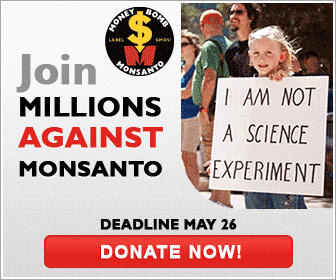
Millions Against Monsanto

I prefer to write posts about how my family stays well and enjoys life, but this subject is so important to me, I'm putting in a plug for it here.


Earlier this year, volunteers in California busied themselves gathering 800,000 signatures (500,000 required) for a ballot initiative to require the labeling of foods containing genetically-modified organisms (GMOs). The California Right to Know Genetically Engineered Food Act has been submitted to the State Attorney General and Californians will cast their votes later this year. The first section summarizes GMO concerns (if you don't know much about it, please read):

SECTION 1: FINDINGS AND DECLARATIONS
  1. California consumers have the right to know whether the foods they purchase were produced using genetic engineering. Genetic engineering of plants and animals often causes unintended consequences. Manipulating genes and inserting them into organisms is an imprecise process. The results are not always predictable or controllable, and they can lead to adverse health or environmental consequences.
  2. Government scientists have stated that the artificial insertion of DNA into plants, a technique unique to genetic engineering, can cause a variety of significant problems with plant foods. Such genetic engineering can increase the levels of known toxicants in foods and introduce new toxicants and health concerns.
  3. Mandatory identification of foods produced through genetic engineering can provide a critical method for tracking the potential health effects of eating genetically engineered foods.
  4. No federal or California law requires that food producers identify whether foods were produced using genetic engineering. At the same time, the U.S. Food and Drug Administration does not require safety studies of such foods. Unless these foods contain a known allergen, the FDA does not even require developers of genetically engineered crops to consult with the agency.
  5. Polls consistently show that more than 90 percent of the public want to know if their food was produced using genetic engineering.
  6. Fifty countries—including the European Union member states, Japan and other key U.S. trading partners—have laws mandating disclosure of genetically engineered foods. No international agreements prohibit the mandatory identification of foods produced through genetic engineering.
  7. Without disclosure, consumers of genetically engineered food can unknowingly violate their own dietary and religious restrictions.
  8. The cultivation of genetically engineered crops can also cause serious impacts to the environment. For example, most genetically engineered crops are designed to withstand weed-killing pesticides known as herbicides. As a result, hundreds of millions of pounds of additional herbicides have been used on U.S. farms. Because of the massive use of such products, herbicide-resistant weeds have flourished—a problem that has resulted, in turn, in the use of increasingly toxic herbicides. These toxic herbicides damage our agricultural areas, impair our drinking water, and pose health risks to farm workers and consumers. California consumers should have the choice to avoid purchasing foods production of which can lead to such environmental harm.
  9. Organic farming is a significant and increasingly important part of California agriculture. California has more organic cropland than any other state and has almost one out of every four certified organic operations in the nation. California’s organic agriculture is growing faster than 20 percent a year.
  10. Organic farmers are prohibited from using genetically engineered seeds. Nonetheless, these farmers’ crops are regularly threatened with accidental contamination from neighboring lands where genetically engineered crops abound. This risk of contamination can erode public confidence in California’s organic products, significantly undermining this industry. Californians should have the choice to avoid purchasing foods whose production could harm the state’s organic farmers and its organic foods industry.
  11. The labeling, advertising and marketing of genetically engineered foods using terms such as “natural,” “naturally made,” “naturally grown,” or “all natural” is misleading to California consumers.
SECTION 2: STATEMENT OF PURPOSE
The purpose of this measure is to create and enforce the fundamental right of the people of California to be fully informed about whether the food they purchase and eat is genetically engineered and not misbranded as natural so that they can choose for themselves whether to purchase and eat such foods. It shall be liberally construed to fulfill this purpose.

Sounds fair, right? All we want is the labeling so we can make an informed choice as to what we eat. The biotech industry does not want to label GMOs because they assume less people will purchase their products (they're probably right). So now comes the campaign fight. Wealthy companies such as Monsanto will likely outspend their opposers by 100 to 1 to persuade people to vote no. The public really needs to understand the health and environmental dangers of GMOs before voting.


From May 1-26, there is a huge push to raise funds for the cause. The Organic Consumers Association is hoping to raise $1,000,000 toward the campaign. If they can do it, a coalition of public interest groups and organic companies have promised to match with an additional million. As of today, they have raised around $750,000.

Even if you live elsewhere, you can help! If this initiative is passed, its effects will reach beyond California. It will pave the way for other states to enact similar laws, and I imagine that many of the positively-labeled foods will be distributed in other states/countries as well. Perhaps we will eventually see a labeling requirement for the whole United States.

I'm donating today. Will you join me?