Pages

Thursday, August 28, 2014

DIY: Installing Airlocks (Cheap, Easy, Fast!)

Well, I'd say we took the summer off blogging, didn't we!? We've all been off galavanting every which way, enjoying the long summer days, and trying new things to share. :)

I've had several inquiries regarding my previous post on making sauerkraut. I'm happy the love is spreading! I have officially installed nine airlocks this summer, and just must share how easy and worthwhile it is.

The point of the airlock is to allow carbon dioxide to escape (put off by the lactic acid-producing bacteria), without reintroducing any oxygen. Those little critters need an anaerobic environment to thrive.

Here's What You Need:
Some airlocks

Some 3/8" grommets

A drill with a 7/16" bit

Here's What You Do

1) Attach the 7/16" bit to your drill (if you find this too tight to slide the airlock in later, you can also use the 1/2" bit, but try the former first).

2) Drill a hole in the top of a mason jar lid. I found it easier to do this while the lid was secured onto a quart jar. Mason jars really seal well, which is why I like to use them, but you could also use a jar with a lid that has a rubber edge around that inside of the lid (like most salsa jars).


3) Fit the grommet into the drilled hole.

4) Carefully press the end of the airlock into the grommet. It doesn't need to go in terribly far, it just needs to be as tight as possible. (Be careful how you put weight onto these cheap airlocks—they can crack, like the one pictured here. We used some super glue on it and thankfully didn't have any leaks.)


5) Ta-da!


6) After you pack the jar with whatever you want to lacto-ferment, be sure to add a little water to the fill-line on the airlock. This helps keep your veggies airtight.

Right away I started fermenting some garden beets and carrots. I found tricky ways of keeping the veggies submerged below the brine. For the beets, I left the largest slices uncut and lodged them down beneath the shoulders of the jars. For the carrots, I used celery slices (which ended up being delicious) and did the same thing. Be sure to leave at least an inch of headspace between the brine and the top of the jar.

 Feel free to stare for a few minutes.
I did.

I left them at a friend's house for a few weeks while I was out of town, so eager to try them upon our return. Wow. I was not disappointed. Neither were my little boys. We all loved them!

Next I did pickling cucumbers, Bubbies style. I kept the cucumbers submerged with grape leaves, which help keep the pickles crisp. Two of the jars are still going (six weeks later) and some of the brine has sunk below the leaves at the top. I can see no sign of mold. Props to the airlocks!

Here they are after three weeks of fermenting.
The airlock water in the first jar is a little 
off-color because some of the escaping 
CO2 tried to drag my brine up with it!

Lastly, I made 5 gallons of sauerkraut (2.5 pictured here, 2.5 in my Harsch crock). I kept the kraut submerged by anchoring a large, firm cabbage leaf beneath the shoulders. The sauerkraut became really bubbly really quick as the first stage of fermentation began. I had to open the jars and re-press the cabbage beneath the brine. I recommend leaving a little more than one inch of headspace, and plenty of brine above the veggies.


I made these five weeks ago.* We've already gone through two of these jars, with three of them (and the crock) still going strong. The flavor is a little different every time I open a new jar (the older it is, the more I like it). When we're ready to dig in, I swap out the airlock lid for a unpunctured lid, and pop it in the fridge, ready to accompany every meal. :)

Honestly, it's a thrill.

*I must admit, I came out liking the airlock method more than the open-vat method (mentioned in the sauerkraut post) for two reasons: 1) I never had to deal with skimming mold off the top, and 2) I found the flavor slightly more complex for the same amount of time.

Monday, May 19, 2014

Sauerkraut: Want It, Love It

When I was 16, I spent a few weeks touring around Europe as part of a youth orchestra. It was unforgettable.

My strongest culinary memory from that trip (aside from Italian gelato and a certain restaurant on the Champs-Elysées) was the sauerkraut in Switzerland. Knowing nothing about it, I wished then that I could forget it. It was rather sour. It smelled funny. I didn't like it. I didn't want it. And I couldn't wrap my mind around its immense popularity.


I wish I could see my teenage self peer into the future and observe in disbelief my love affair with this fermented cabbage now. It is deliciously sour and impressively complex. I love it. I crave it. I eat it almost every day. If it runs out—tragedy.

A standout in the repertoire of lacto-fermented foods, sauerkraut packs a powerful punch. The fermentation occurs as tiny little bacteria called lactobacilli happily feed on the starches and sugars in the food, producing lactic acid (thus lacto-fermentation). This amazing, transformative process
  • perfectly preserves the food
  • enhances digestibility
  • increases vitamin levels 
  • creates new nutrients 
  • removes toxins from the food
  • produces beneficial enzymes as well as antibiotic and anticarcinogenic substances 
  • inhibits growth of bad bacteria, not only on the food but also in your gut (that is, it would give E. coli a good fight if it happened to show up down there)
  • breaks down phytic acid, even in the gut
  • promotes healthy gut flora (probiotic), thereby strengthening your immunity
  • produces a complex flavor that evolves with age

Wow. Raise your hand if you want some of THAT!

Whether you want it or not, you do need it. As you make it and eat it, little by little you will start to crave it and love it. Your body will recognize the good it's doing and keep reminding you. When I have encountered sugar cravings, taking a few bites of sauerkraut instead has been both satisfying and healing. My body sings its praises after every little bite.

A caution: many brands of sauerkraut available in stores have been pasteurized, killing the beneficial microorganisms we so desire. In order to reap the deep benefits, you have to make it yourself.

Fortunately, it's easy! If you've never lacto-fermented anything before, sauerkraut is a great place to start. I suggest reading the whole recipe before starting. Here we go!


BASIC SAUERKRAUT

Ingredients
For every pound of organic cabbage, use 2 tsp. sea salt

Equipment
  • A sharp knife
  • A cutting board
  • A scale (if you don't have one, weigh your cabbages at the market, keeping in mind that you'll be coring them) 
  • A large mixing bowl
  • Fermentation vessel of choice (you can use a regular mason jar)*

Directions
1) Technically this step is optional, but I like to start by sharpening up my knife a little to expedite the cutting, especially if I'm making a big batch (which is always).


2) Remove outer cabbage leaves. Cut and core the cabbage.


3) Shred the cabbage. (You can use a food processor if you want, but I prefer the consistency I achieve with a knife.)


4) Weigh the cabbage, adding the salt as you go. The salt preserves the cabbage as the pH drops during the first few days of fermentation.


5) Squeeze and press the juice out of that cabbage! You can go nuts and do it all at once OR you can let the cabbage and salt sit together for a while to help draw out the juices before pressing (which you can do right in your fermentation container, if you like). This can take hours or even a whole day if it suits you.


6) Using a small implement (e.g. a little jar, meat hammer, potato masher, one of these fancy crushers, or your fists), pack the cabbage tightly into your fermentation container, getting rid of as many air bubbles as possible. Leave at least one inch between the juice and the top of your jar (the sauerkraut will expand). If you're having trouble getting the juices to rise above the cabbage, you may add some salt water (1 tablespoon sea salt dissolved in 1 cup filtered water) as needed. I have rarely needed to add water, but it won't ruin your ferment to do so. :)

My Harsch crock, stored under the sink

7) Sauerkraut requires an anaerobic environment to ferment, so you need to keep the cabbage submerged under the brine to avoid spoilage. If you're using a mason jar without an airlock, use one of the two following methods:
  1. Leave the jar open, but weigh the cabbage down with something heavier so the brine stays well above it. Keep your eye on your kraut. If you notice a thin white film forming atop your brine, just skim it off. You're welcome to taste and stir your sauerkraut whenever you like. 
  2. Close the jar tightly and put it in a cool, dark corner of your kitchen. The lactobacilli put off CO2 that needs to be released, so if you choose this method, you should "burp" the jar every few days by loosening the ring and allowing the CO2 to escape. You can also take this opportunity to taste your kraut. You will notice the flavor changing as the fermentation progresses.
8) Wait. You have to be patient. Sauerkraut goes through three stages of fermentation, and you get the most benefit out of it if you wait a minimum of four weeks (see "mistake #1" in that post). Remember, the cabbage must stay submerged under the brine.

9) When you taste the sauerkraut, trust your instincts. Sauerkraut has a high success rate (I don't think I've ever botched a batch), but occasionally one might go bad. This post includes some visuals that might warn of an improper ferment (see "mistake #2," though if you use any purple cabbage to begin with, then "pink cabbage" is not going to be an indicator of spoilage). Above all, trust your gut!

10) There are lots of ways to eat it. Like this:


This:


Or even this (the juice is an amazing digestive tonic!):


Or whatever tickles your fancy or tempts your palate. It can be eaten plain or added to just about anything—salads, sandwiches, smoothies, warm soups—and it's notoriously good with meats.

I hereby wield the power of the Daily Dare and challenge you to make some sauerkraut and eat it! I promise that if you make it, wait patiently for it to transform, and consume it regularly, you will reap tremendous health benefits. You will want it.

Once you've made it a couple times, you'll be ready for sauerkraut's foreign cousins, kimchi and cortido (coming soon!).

~~~~~

Some of my resources on lacto-fermentation:
  • Wild Fermentation by Sandor Katz (he has a couple other good ones, too)
  • Real Food Fermentation by Alex Lewin
  • Nourishing Traditions by Sally Fallon (just a section dedicated to it in this book)
  • Lacto-Fermentation eBook by GNOWFGLINS (Wardee also recently published a book called The Complete Idiot's Guide to Fermenting Foods, which I don't have)
  • Lacto-Fermentation eBook by Cultures for Health (free online!)

*An Important Word on the Vessel
Some recipes call for using a plain old mason jar. I fermented this way many times before a wonderful person gave me a 10-liter Harsch crock a year ago. Everyone seems to have a different idea about fermenting in mason jars. Some think it's best to have a container that can release the gases produced by the lactobacilli without allowing more oxygen into the jar (using something like these, or here's a more economical DIY for attaching an airlock to your mason jar lid).

At least one blogger has stirred up some controversy regarding the safety and efficacy of lacto-fermenting in mason jars. Here is another blogger's responses to those circulating concerns. Traditional fermentation expert Sandor Katz is not at all concerned about using an open ferment method, as long as the food is clearly submerged beneath the brine. The post I referenced above (with the three common fermenting mistakes) contains good information on how to ferment optimally (staying totally anaerobic, avoiding mold, getting consistent results, and increasing lactobacilli) as well as lots of interesting discussion in the comments. Also, do check out this cool experiment (18 different vessels for 28 days).

All that said, I personally think mason jars are a fine place for someone to start out their fermentation journey. Better there than not at all! I did it many times before using a crock, and I never experienced anything but wholesomeness. :)

Tuesday, April 29, 2014

The Soggy Lettuce Conundrum (and How to Stop It)

Sometimes I lose produce before I can use it.

Well, it actually happens less often since I stuck this nifty sticky whiteboard to my fridge. Now I write down all our produce and perishable leftovers so I remember what's going on in my kitchen (both in and out of the fridge).

I took this photo back in January (probably after a CSA box 
or a trip to the Farmer's Market since there's so much on there).

I have always hated losing produce. It's such a waste, not only of the food itself, but of everything it took to grow that food.

I recently watched this TED talk by Leyla Acaroglu called Paper beats plastic? How to rethink environmental folklore. I think all 18 minutes are worthwhile. I've watched it twice.


Toward the beginning of the talk, Acaroglu points out that biodegradability is "a material property, not a definition of environmental benefit." That got me slowly nodding my head. She went on:
When something natural [like food waste or paper] ends up in the natural environment, it degrades normally. Its little carbon molecules that it's stored up as it was growing are naturally released back into the atmosphere as carbon dioxide. But this is a net situation. Most natural things don't actually end up in nature. Most of the waste that we produce ends up in landfill. Landfill is a different environment. In landfill, those same carbon molecules degrade in a different way because a landfill is anaerobic. It's got no oxygen. It's tightly compacted and hot. Those same molecules, they become methane, and methane is a 25x more potent greenhouse gas than carbon dioxide. So our old lettuces and products that we have thrown out that are made out of biodegradable materials, if they end up in landfill, contribute to climate change.
Whoa, what? When I throw the soggy lettuce in the trash, it's destiny is methane? When I toss a piece of paper in the trash, it's destiny is probably methane?? Why did this never occur to me?

Realizing this actually made me glad about two things.

First, that we compost, which means that this:


turns into this:


We use it to enrich the soil and feed the earthworms. :)

However, when the compost tumbler is a-tumbling, I don't add anything to it for several weeks (which is why having two would be awesome). So, second, when I can't add my biodegradables to the composter, I typically toss them behind these lovely bushes in the front yard. 


Here's a close-up:


When I started doing this over a year ago, I figured that even though I couldn't use the compost how I'd like, I was still feeding the earth. Something beautiful will grow there some day.

I'm happy to have another way to care for the earth in my arsenal, and a good reason for doing so!

If composting isn't an option for you at the moment, is there somewhere else you can toss those kitchen scraps so they don't wind up in a landfill? If you don't have a yard, you could always add your scraps to broth or soups to get more life out of them. I bought an eBook bundle once that included one called Don't Compost It, Cook It. I haven't read it thoroughly, but the the author has some good ideas for getting as much mileage as possible out of your food.

How do you avoid losing produce? How do you make use of any peelings and trimmings?

Monday, April 21, 2014

Children's Books for Loving the Earth

Over the months, we have discovered a number of children's books (mostly from the library) that have enhanced our love for the earth and our determination to take good care of it. Here are some of our favorites, just in time for Earth Day tomorrow.

Please share the books you and your kids love!

Uno's Garden 
by Graeme Base
Uno watches his beloved forest home slowly transform into a booming metropolis. As the populous grows, the unique indigenous creatures decline. What can be done to save them? Filled with imaginative beauty typical of Graeme Base, this book is also full of fun arithmetic and a wonderful message about the importance of keeping balance with nature.


The Barefoot Book of Earth Tales 
by Dawn Casey and Anne Wilson
This is a beautiful collection of tales from seven diverse countries. The colorful, captivating writing brought me to the edge of tears several times, but my little boys loved them, too! Along with each story is an activity relating in some way to the culture (e.g. make a cornhusk doll, build a willow den, make a mini water garden).


Earth Mother 
by Ellen Jackson, illustrated by Leo and Diane Dillon
In this light-hearted story, Earth Mother goes about ornamenting and caring for the earth in beautiful dress. During her travels, she receives both the thanks and complaints of a toiling man, a frog, and a mosquito, all of whom have insights to gain about the circle of life.


A River Ran Wild 
by Lynne Cherry
This book chronicles the history of the Nashua River in Massachusetts, from the first native settlers to the industrial revolution, which saw factories crop up along it's banks, filling the river with toxic waste. One woman spearheaded a great effort to return the river to its pristine state. (
Incidentally, we recently finished reading the original Boxcar Children books, and one of the books, "Bus Station Mystery," told a very similar story, but without any proper names. It was written around the time of the big cleanup and in the same part of the country, so maybe the Nashua inspired her, too.)

All the Water in the World 
by George Ella Lyon and Katherine Tillotson
A lovely, lyrical presentation of the water cycle.


Brother Sun, Sister Moon: Saint Francis of Assisi's Canticle of the Creatures
by Katherine Paterson, illustrated by Pamela Dalton
Illustrated with watercolored papercuttings, this version of St. Francis of Assisi's famous prayer lends a sweet and strong reminder that God loves his creations and we should, too! 

The Curious Garden 
by Peter Brown
Growing up in a city with no plant life, a young boy discovers some dying plants growing along an abandoned railroad track, and decides to take care of them. As his plants begin to spread, so does his passion to cultivate.

City Green 
by DyAnne DiSalvo-Ryan
A little girl inspires her neighbors to join with her in transforming the old, city-owned, junk-filled lot next to her apartment building into a thriving garden. Besides changing the ugly lot, their efforts also change a heart or two.

Secrets of the Garden: Food Chains and the Food Web in Our Backyard 
by Kathleen Weidner Zoehfeld, illustrated by Priscilla Lamont
This was a fun read about the ins and outs of raising a family garden, including planning, planting, composting, handling pests, and preserving the bounty. Lots of extra information (provided by chickens) includes a helpful discussion on the food web.

Market Day 
by Lois Ehlert
One farmer family takes a day trip to sell their produce at the market. The illustrations are compilations of folk art from all over the world. 

To Market, to Market 
by Nikki McClure
From the perspective of a boy attending attending his local farmer's market with his family, we meet many of the market vendors and learn about the efforts they make to produce their wares.

Brother Eagle Sister Sky 
by Susan Jeffers
Though the origin of this book is controversial (purportedly from a speech by American Indian Chief Seattle), the message about respecting the interconnected web of life is a good one! 


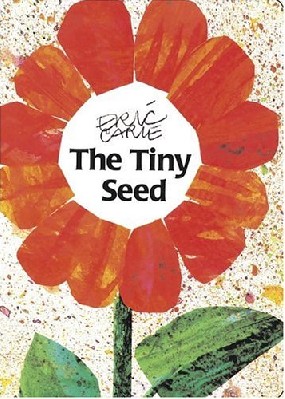
The Tiny Seed 
by Eric Carle
This is a nice story about the life cycle of a seed. One adventurous seed starts out tinier than the others, but in the end grows tallest of all. 

The Apple Pie Tree 
by Zoe Hall, illustrated by Shari Halpern
Two little girls watch the evolution of their family apple tree from bare-branch winter to autumn harvest.

A Promise is a Promise 
by Eve Tharlet
A little marmot becomes best friends with a dandelion, who eventually asks the marmot to blow her seeds to the wind, and trust that everything will be okay. After a lot of worry and a good hibernation, he awakes to a beautiful surprise. 

Anno's Magic Seeds 
by Mitsumasa Anno
A wizard gives Jack two magic seeds. He tells him to eat one and bury the other, promising that it will produce two more in the fall. A mathematical story of the miraculous multiplying and saving potential hidden in every little seed.

Wangari's Trees of Peace 
by Jeanette Winter
After completing her studies abroad, Wangari Maathai returns to her native Kenya to find many of the old forests destroyed. Beginning in her own backyard, she begins planting trees, eventually persuading other women of her town and country to assist in the efforts. They plant 30 million trees. 


Mama Miti 
by Donna Jo Napoli, illustrated by Kadir Nelson
Another take on Wangari, this book shows in dazzling illustration her confident response to the variety of problems coming from women all over Kenya: "Plant a tree!" 

Aside: in 2004 Wangari received the Nobel Peace Prize for her contributions to sustainable development, democracy, and peace. I read her bio on wikipedia and was amazed at her life! There are many earth-lovers who have made similar efforts and sacrifices. You might enjoy learning about:

John Muir
Rachel Carson
Jacques Cousteau
Gaylord Nelson
And many more, I'm sure!

Here are a few more books that are either educational (without a storyline) or compilations of earth-centered activities. You might like:

One Well: the Story of Water on Earth 
by Rochelle Strauss, illustrated by Rosemary Woods
Earth's water supply is essentially one big well. This book talks all about water: the water cycle, our collective need for water, access to water, water pollution, and becoming "well aware."

What's So Special About Planet Earth? 
by Robert E. Wells
This book encourages kids to value our world by taking a look at how it is suited uniquely for us. At the end he shares some ideas for conserving resources and using energy wisely.

Best Kids Love-the-Earth Activity Book 
This is a terrific compilation of ideas for understanding and exploring the earth. Here is just a smattering from this book: design a nature collage, pound a leaf into fabric, make sun tea, make fresh water from salt water, make wind-powered music, make a bird hangout, host a party for the planet, dye earth-friendly easter eggs (which I tried this year, though not from this book), and LOTS of ideas for reusing various materials.

My First Green Book: A Life-Size Guide to Caring for our Environment 
by Angela Wilkes
Though a little old-school, this book has some good stuff. It includes information on an array of subjects ranging from waste disposal to the rain forest and features activities such as testing your own water and soil, making a water filter, creating a wildlife garden, and campaigning for change.

Love Your World: How to Take Care of the Plants, the Animals, and the Planet 
by Dawn Sirett
This was a favorite for my kids. It contains lots of colorful pictures and little poems about loving and caring for the earth, encouraging kids to make a difference!

HAPPY EARTH DAY!!
(You can celebrate Earth Day as long as you want.)