Pages

Showing posts with label Education. Show all posts

Thursday, August 6, 2015

Rachel Reed

Have you ever heard of Rachel Reed? She is so many things, such as midwife, university lecturer, Doctor of Philosophy, and the writer of the beautiful blog Midwife Thinking. She carries with her knowledge for women who want good birth experiences, and for those who have had bad ones, she can help bring healing. She is compassionate. 

I would here like to introduce you to her writings, because she has been such a solid voice for me in my travelings in and out of the world of labor and delivery. She is honest and forthright, and she is kind. She cares very much for mothers. I wish we were neighbors to be honest.

I hope you can glean as much from her as I have. If you already know of her, which of her blog posts have you loved best? It is difficult to say, but I think these two might be my favorite. (Each word there has a different link.)

Have a lovely night!

P.s. If you click on her 'about' tab, you will find her resume. It is beyond impressive!

Wednesday, March 26, 2014

Creativity Part 1: Music Writing, Photoshopping, & Movie Making

I have been thinking a lot about creativity. There are so many different ways to create—craft something by hand, doodle, write a song or a poem, garden, design your home, cook, the possibilities are literally limitless.  Yet there are also so many ways to consume what others have created.  Consuming is so much easier, especially with so much available at the click of a mouse, or the drop of a couple of dollars.  Entertainment is cheap, and creativity takes real work.


At least for me, the hardest part is getting started.  I have asked a few wonderfully creative people I know how they get started and find inspiration, and I’ll be sharing their responses here over the next few weeks. 

This first post is by my wonderful, talented husband, Andrew.  He is extremely creative, always making something: movies, doing photoshops, and for me the hardest--writing original songs.  He writes me a completely original valentines song every year!  I know how hard it is, because I tried last year to write him one--really tried, and it was a complete joke.  Here are some of Andrew's thoughts on creativity.

For me, creativity is a two-way street. Much of what I create, I do with the consumer of my creation in mind. Whether it's a Valentine's Day song for Ariel, a birthday photoshop for a sibling or a training module at work, it's often with the audience in mind. This audience can be as narrow as a specific person and as a broad as the Internets. I think meaningful creations should evoke emotion. When I am getting started with a big or small creative project, I ask myself the question: What emotion do I want to evoke with my creation? Love, joy, frivolity, peace, strength, nostalgia, excitement? The expected emotion then propels the craft. From there a story will swirl through an image, a melody, an idea. I try to infuse that emotion into the creation with the hope that the consumer can experience shared emotion. Though to be clear, I don't necessarily want to dictate what the consumer feels, but it helps me get started to have something that I want to project in mind. 

Creativity has great effect when the creation evokes emotion through story. 

Below are some examples of his handiwork.
A birthday photoshop for a sister


A fun Christmas card to send to colleagues at work
And most impressive, here is a link to all of Andrew's Valentine's Day Songs.  The 4th song is probably my favorite (though it's hard to choose!).  It's a beautiful song he wrote after Abraham (our #1) was born, to tell the story of his birth in epic-song-fashion.

Here is a fun music video we made for one of the Valentine's Day songs (making movies has turned into a fun family tradition).

Thursday, November 21, 2013

On Books

Andrew and I read together last night an old email from his wonderful scholarly father that was a wonderful compilation of quotes from church history about books and study.  Enjoy!

Hugh Nibley, Approaching Zion 296

We are commanded in D&C 109:14-16 . . . to build a house of study.  There people were to "seek . . . out of the best books words of wisdom" (D&C 88:118).  A list of the best books had not yet been supplied.  We must find these ourselves by diligently searching.  If the scriptures bind the worlds together, the writings of man bind together the generations and the dispensations.

Joseph F. Smith, Gospel Doctrine 235

Read good books. Learn to sing and to recite, and to converse upon subjects that will be of interest to your associates, and at your social gatherings, instead of wasting the time in senseless practices that lead only to mischief and sometimes to serious evil and wrongdoing; instead of doing this, seek out of the best books knowledge and understanding. Read history. Read philosophy, if you wish. Read anything that is good, that will elevate the mind and will add to your stock of knowledge, that those who associate with you may feel an interest in your pursuit of knowledge and of wisdom.
Teachings of Ezra Taft Benson 304

With the abundance of books available, it is the mark of a truly educated man to know what not to read. "Of making many books there is no end" (Ecclesiastes 12:12). In your reading you would do well to follow the counsel of John Wesley's mother:  Avoid "whatever weakens your reason, impairs the tenderness of your conscience, obscures your sense of God, takes off your relish for spiritual things, [and] increases the authority of the body over the mind."

The fact that a book or publication is popular does not necessarily make it of value. The fact that an author wrote one good work does not necessarily mean that all his books are worthy of your reading. Do not make your mind a dumping ground for other people's garbage. It is harder to purge the mind of rotten reading than to purge the body of rotten food, and it is more damaging to the soul.
Brigham Young, JD 9:174, January 26, 1862

Novel reading--is it profitable? I would rather that persons read novels than read nothing. There are women in our community, twenty, thirty, forty, fifty, and sixty years of age, who would rather read a trifling, lying novel than read history, the Book of Mormon, or any other useful print. . . . I would advise you to read books that are worth reading; read reliable history, and search wisdom out of the best books you can procure. How I would be delighted if our young men would do this, instead of continually studying nonsense.
As a side note, there were also two interesting and relevant food news stories on NPR this morning, one bad one good:


I can't find the original NPR story, but this is about the same study

Nut consumption reduces risk of death

Tuesday, July 30, 2013

The Poems of Alan Alexander Milne

Jonathan Jo
Has a mouth like an "O"
And a wheelbarrow full of surprises;
If you ask for a bat,
Or for something like that,
He has got it, whatever the size is.

If you're wanting a ball
It's no trouble at all;
Why, the more that you ask for, the merrier––
Like a hoop and a top,
And a watch that won't stop,
And some sweets, and an Aberdeen terrier.

Jonathan Jo has a mouth like an "O"
But this is what makes him so funny:
If you give him a smile,
Only once in a while,
Then he never expects any money!


Some of my strongest childhood memories include the poems of English writer A.A. Milne (1882-1956). I can still hear my dad's voice reciting "Lines and Squares," "Disobedience," and "Jonathan Jo" and my mom's voice in "The King's Breakfast" and "The End." I'm sure I say them to my children now with the exact intonation my parents once spoke them to me. Many other Milne poems adorned my childhood in some way or another (e.g. King's Singers albums, Muppets sketches...).

Best known for his stories about the adventures of Winnie-the-Pooh in the Hundred Acre Wood, A.A. Milne's poems are absolutely not to be missed. I never tire of them. Based on my memories of childhood and observations of my own little boys, I think he thoroughly understand the workings of a child's mind and heart (in fact, for this reason, all adults should read them). Ernest Shepard's accompanying "decorations" are equally charming. Whether or not you have children at home, the poetry books When We Were Very Young and Now We Are Six are worthy additions to precious bookshelf space.

Call any nearby children to your knee right now and enjoy a few of my favorites together. If you are alone, no matter. You might be pleased to catch a glimpse of yourself in some of these words.

Market Square

I had a penny,
A bright new penny,
I took my penny
To the market square.
I wanted a rabbit,
A little brown rabbit,
And I looked for a rabbit
'Most everywhere.

For I went to the stall where they sold sweet lavender.
("Only a penny for a bunch of lavender!")
"Have you got a rabbit, 'cos I don't want lavender?"
But they hadn't got a rabbit, not anywhere there.

I had a penny,
And I had another penny,
I took my pennies
To the market square.
I did want a rabbit,
A little baby rabbit,
And I looked for rabbits
'Most everywhere.

And I went to the stall where they sold fresh mackerel.
("Now then! Tuppence for a fresh-caught mackerel!")
"Have you got a rabbit, 'cos I don't like mackerel?"
But they hadn't got a rabbit, not anywhere there.

I found a sixpence
A little white sixpence.
I took it in my hand
To the market square.
I was buying my rabbit
(I do like rabbits)
And I looked for my rabbit
'Most everywhere.

So I went to the stall where they sold fine saucepans.
("Walk up, walk up, sixpence for a saucepan!")
"Could I have a rabbit, 'cos we've got two saucepans?"
But they hadn't got a rabbit, not anywhere there.

I had nuffin',
No, I hadn't got nuffin',
So I didn't go down
To the market square;
But I walked on the common,
The old-gold common . . .
And I saw little rabbits
'Most everywhere!

So I'm sorry for the people who sell fine saucepans,
I'm sorry for the people who sell fresh mackerel,
I'm sorry for the people who sell sweet lavender,
'Cos they haven't got a rabbit, not anywhere there.


Happiness

John had
Great Big
Waterproof
Boots on;
John had a
Great Big
Waterproof
Hat;
John had a
Great Big
Waterproof
Mackintosh––
And that
(Said John)
Is
That.


Come Out with Me

There's sun on the river and sun on the hill . . .
You can hear the sea if you stand quite still!
There's eight new puppies at Roundabout Farm––
And I saw an old sailor with only one arm!

But every one says, "Run along!"
(Run along, run along!)
All of them say, "Run along! I'm busy as can be."
Every one says, "Run along,
There's a little darling!"
If I'm a little darling, why don't they run with me?

There's wind on the river and wind on the hill . . .
There's a dark dead water-wheel under the mill!
I saw a fly which had just been drowned––
And I know where a rabbit goes into the ground!

But every one says, "Run along!"
(Run along, run along!)
All of them say, "Yes dear," and never notice me.
Every one says, "Run along,
There's a little darling!"
If I'm a little darling, why won't they come and see?


Knights-in-Armor

Whenever I'm a shining Knight,
I buckle on my armor tight;
And then I look about for things,
Like Rushings-Out, and Rescuings,
And Savings from the Dragon's Lair,
And fighting all the Dragons there.
And sometimes when our fights begin,
I think I'll let the Dragons win . . .
And then I think perhaps I won't,
Because they're Dragons, and I don't.


The Engineer

Let it rain!
Who cares?
I've a train
Upstairs,
With a brake
Which I make
From a string
Sort of thing,
Which works
In jerks,
'Cos it drops
In the spring,
Which stops
With the string
And the wheels
All stick
So quick
That it feels
Like a thing
That you make
With a brake,
Not string . . .

So that's what I make,
When the day's all wet.
It's a good sort of brake
But it hasn't worked yet.


Vespers

Little Boy kneels at the foot of the bed,
Droops on the little hands little gold head.
Hush! Hush! Whisper who dares!
Christopher Robin is saying his prayers.

God bless Mummy. I know that's right.
Wasn't it fun in the bath tonight?
The cold's so cold, and the hot's so hot.
Oh! God bless Daddy––I quite forgot.

If I open my fingers a little bit more,
I can see Nanny's dressing-gown on the door.
It's a beautiful blue, but it hasn't a hood.
Oh! God bless Nanny and make her good.

Mine has a hood, and I lie in bed,
And I pull the hood right over my head,
And I shut my eyes, and I curl up small,
And nobody knows that I'm there at all.

Oh! Thank you, God, for a lovely day.
And what was the other I had to say?
I said, "Bless Daddy," so what can it be?
Oh! Now I remember. God bless Me.

Little Boy kneels at the foot of the bed,
Droops on the little hands little gold head.
Hush! Hush! Whisper who dares!
Christopher Robin is saying his prayers.


Do you have a favorite you'd like to share?
What other children's poets do you love?

Monday, June 25, 2012

Classical Education: Birth to Three

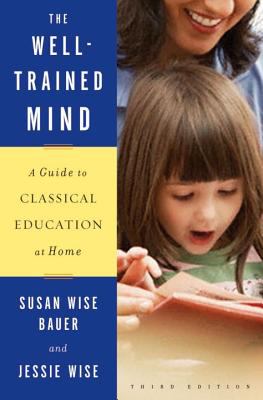
Last week, I posted a brief intro on classical education according to The Well-Trained Mind: A Guide to Classical Education at Home by Susan Wise Bauer and Jessie Wise. Since we (the blog authors) all have very young kids, I'd like to summarize their recommendations for the first three years (pp. 27-30). Perhaps I'll do another follow-up with their advice for 4-5-year-old preschoolers.

"When you educate your child at home, you don't have to draw a line between parenting and teaching" (p. 26). The bottom line is to immerse your child in language from birth, though the authors share specific ideas for preparing children to learn reading, writing, and math.

Reading Preparation: "Prereading preparation works. Susan [the coauthor daughter] was reading on a fifth-grade level in kindergarten... If you create a language-rich home, limit TV and videos, and then teach systematic phonics, you will produce readers."
  • TALK: Talk constantly. Explain what you're doing and why. "This sort of constant chatter lays a verbal foundation in your child's mind. She's learning that words are used to plan, to think, to explain; she's figuring out how the English language organizes words into phrases, clauses, and complete sentences."
  • READ: Read all the time. Start with sturdy books ("a torn book or two is a small price to pay for literacy"). Read picture books, pointing to the words with your finger, then read them again and again. "Repetition builds literacy." Read longer books out loud with baby playing nearby. 
    • After reading together, ask your child questions about the story. "What did the gingerbread boy do when the old woman tried to eat him? When the dog got to the top of the tree at the end of Go, Dog, Go, what did they find? What happened after Bananas Gorilla stole all the bananas?"
    • Record yourself reading, singing, reciting, and telling stories for the child to listen over and over.
      • To this day, I remember the bedtime tape that my parents made for us to listen to as we fell asleep. I can quote those stories and poems with the same inflections that my parents told them (Mom's Puffin, Put a Poem in Your Pocket, Frog and Toad stories, Dad doing all sorts of A.A. Milne poems...).
  • ALPHABET: Teach your child the alphabet as soon as she starts speaking. Sing the alphabet song, read alphabet books, put the letters up on the wall. Teach her the sounds of the letters just as you teach the sounds of the animals. "Pigs say oink; dogs say woof; B says b, b, b." 
    • Start with the sounds of the consonants. "Tell her that b is the sound at the beginning of bat, ball, and Ben; say, 'T, t, tickle' and 'M, m, mommy' and 'C, c, cat.'"
    • "Then tell her that the vowels are named A, E, I, O, and U. Sing, 'Old McDonald had a farm, A, E, I, O, U.'" Emphasize that each vowel has a sound just as each animal makes a sound, and teach only the short sounds of the vowels at first: "A as in at," "E as in egg," etc.

Writing Preparation: "Continual drawing and making counterclockwise circles will prepare the preschooler for kindergarten writing."
  • Teach your child to hold the pencil correctly from the beginning. Draw lots of circles and loops in a counterclockwise direction, as most printed letters use counterclockwise circles. "Make snowmen, Slinkies, smoke from a train, car wheels, and so forth counterclockwise."
  • Before a young child can hold a pencil, let her form numbers, letters, and circles without one. If she wants to use one, "she can use chalk on a big chalkboard or a crayon or pencil on large sheets of paper. Regular-diameter short pencils are often easier for small fingers than fat 'preschool' pencils."
  • Create basic dot-to-dots for your three-year-old (a house, a smiley face) using several big dots. Then guide the child's crayon from one dot to another to see the picture emerge.

Math Preparation: "Start to make your child 'mathematically literate' in the toddler years. Just as you read to the toddler, surrounding her with language until she understood that printed words on a page carried meaning, you need to expose her to mathematical processes and language continually. Only then will she understand that mathematical symbols carry meaning."
  • Make numbers a part of everyday life. "Start with counting: fingers, toes, eyes, and ears; toys and treasures; rocks and sticks. Play hide-and-seek, counting to five and then to ten, fifteen, or twenty together. Count by twos, fives, and tens before shouting, 'Coming, ready or not!' Play spaceship in cardboard boxes, and count backward to takeoff."
    • Each night, we count with Daniel before turning off the lamp. We started by counting to three, and eventually he started saying it himself. So we gradually added numbers, and now at 21 months, he can count to ten by himself! Maybe that's not unusual, I'm just constantly impressed by how these little guys can learn.
  • Read number books together.
  • Once the child is comfortable counting, start working on simple math sums (usually during the K-4 and K-5 years).

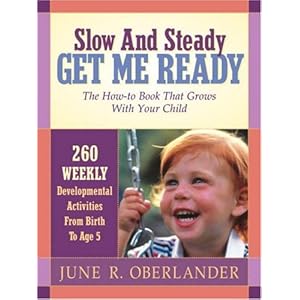
As a general preschool learning resource, the authors recommend June R. Oberlander's Slow and Steady, Get Me Ready, "a birth-to-age-5 activity book that provides a new, developmentally appropriate activity for each week of life. Week 1 begins with exercising the newborn's arms and legs; age 5, week 52, ends with learning to pack an overnight bag. In between, Oberlander (a kindergarten teacher) covers everything from playing peekaboo and learning "in" and "out" through tying shoes, memorizing telephone numbers, bouncing balls, and singing the alphabet while making a different body movement for each letter. It's a complete preschool in one volume. You may not feel you need this resource, but by combining the prereading instruction of the Oberlander book with lots of active play, you'll have the at-home equivalent of an excellent preschool program."
  • I found an online pdf of this book here if you'd like to peruse.

You'll probably be pleased to see that you do some of this preschooling naturally at your house, but if you're an idea-stealer like me, you're always happy for some good ones!

Got more to share?

Thursday, June 21, 2012

A Classical Education at Home

We are leaning toward homeschooling our kids, though it's daunting to consider. What do I do? What do I teach? How do I learn it all? What's the best way? There are countless philosophies, ranging from one extreme to the other with everything in between. I've barely scratched the surface in discovering my options, let alone exploring them. Fortunately, the whole idea of homeschooling allows for endless flexibility.

For my birthday last month, Keenan gave me a resource I've been curious about: The Well-Trained Mind: A Guide to Classical Education at Home by mother-daughter duo Susan Wise Bauer and Jessie Wise. I was impressed at the biographical merits of these women. Their experience and education more than qualify them as guides for parents who are eager to give their children a classical education at home.


What is Classical Education?
If you're like me, you're not sure exactly what is meant by "classical education." This post provides but a scant overview, based on what I've read so far. Here is a snippet from the Introduction (p. xxii):
What is a classical education?
It is language-intensive -- not image-focused. It demands that students use and understand words, not video images.
It is history-intensive, providing students with a comprehensive view of human endeavor from the beginning until now.
It trains the mind to analyze and draw conclusions.
It demands self-discipline.
It produces literate, curious, intelligent students who have a wide range of interests and the ability to follow up on them.
The Well-Trained Mind is a handbook on how to prepare your child to read, write, calculate, think, and understand.
How is the Curriculum Structured?
This book is a textbook in itself. It "provides information on teaching all the subjects in the classical curriculum for all twelve grades -- literature, writing, grammar, history, science, math, Latin, modern languages, art, music, debate, and more" (p. xxv).

The structure is based around a three-part process to training the mind, called the classical pattern of the trivium (from pp. 13-14, a bit reworded):
  1. The "grammar stage" (grades 1-4) prepares the mind to absorb information through memorization of facts: rules of phonics and spelling, rules of grammar, poems, the vocabulary of foreign languages, the stories of history and literature, descriptions of plants and animals and the human body, the facts of mathematics, etc.
  2. The "logic stage" (grades 5-8) builds on the facts absorbed in the first phase. It is a time when the child begins to pay attention to cause and effect, to the relationships among different fields of knowledge, to the way facts fit together into a logical framework. At this age, the mind naturally begins to think more analytically. A student is ready for the logic stage when the capacity for abstract thought begins to mature. During this time, the student learns algebra and logic, and begins to apply logic to all academic subjects.
  3. The "rhetoric stage" (grades 9-12) is the final phase of a classical education, and builds on the first two. At this point, the high-school student learns to write and speak with force and originality. The student of rhetoric applies the rules of logic learned in middle school to the foundational information learned in the early grades and expresses conclusions in clear, forceful, elegant language. The student also begins to specialize in whatever branch of knowledge attracts her; these are the years for art camps, college courses, foreign travel, apprenticeships, and other forms of specialized training.
I find it interesting how the system is centered around history: "To the classical mind, all knowledge is interrelated... A classical education [takes] history as its organizing outline, beginning with the ancients and progressing forward to the moderns in history, science, literature, art, and music" (pp. 14-15). The authors recommend that the twelve years of education consist of three repetitions of the same four-year pattern: the ancients (5000 B.C. - A.D. 400), the medieval period through the early Renaissance (400-1600), the late Renaissance through early modern times (1600-1850), and modern times (1850-present). "The child studies these four time periods at varying levels -- simple for grades 1 through 4, more difficult in grades 5 through 8... and taking an even more complex approach in grades 9-12." I was fascinated by the descriptions and examples of how the other areas of the curriculum are linked to history studies, but this post is already too long to share!

Children Can Do Hard Things
The authors emphasize that the benefits of this education are not exclusively academic:
Rigorous study develops virtue in the student: the ability to act in accordance to what one knows to be right. Virtuous men (or women) can force themselves to do what they know is right, even when it runs against their inclinations. Classical education continually asks a student to work against her baser tendencies... in order to reach a goal -- mastery of a subject (p. 17). 
As a Suzuki violin teacher who requires daily practice from my students, these words couldn't ring truer. Yes, working daily at something difficult but worthwhile gives a student proficiency, but even more valuable are the dozens of life skills absorbed throughout the process.

Still Daunted?
I am. Truth be told, this book hasn't helped the intimidated parent factor much. But the authors insist that any parent can succeed.
All you need to teach your child at home is dedication, some basic knowledge about how children learn, guidance in teaching the particular skills of each academic subject, and lots of books, tapes, posters, kits, and other resources. This book will provide you with everything except the dedication (p. xxii). 
Maybe I can muster that. ;) I don't know yet if classical education is a match for my family, but it's been interesting to study. In fact...

STAY TUNED!
The first item that popped out at me from the Table of Contents was the little section called Preschool: Birth to Three. This is what I originally intended to blog about today, but as I got going, it seemed a basic introduction was necessary. You can watch for that post next week.

Do you know any homeschoolers who follow a classical education? Please share your thoughts!