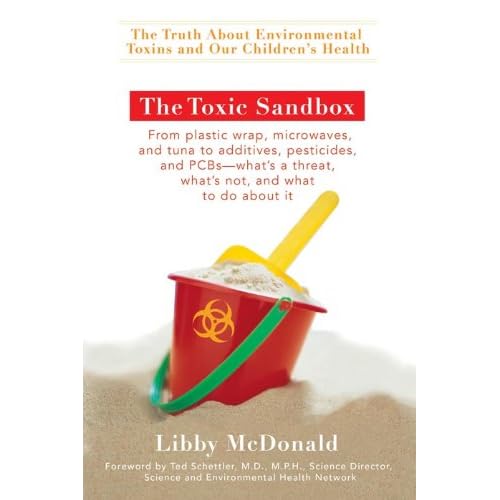
Over the past several years, we have altered what we put both in and on our bodies, taking care to keep out anything questionable. I feel empowered as I've gained more control over the health of my family. A friend lent me this book a couple weeks ago, and I loved it and hated it! Some of the information in this book scares me, as a few of the ill effects mentioned are out of my control. At the same time, I am grateful to be armed with more knowledge to increase the wellness of my family.
The author, Libby McDonald, is a mother who was spurred to research after her young son had an elevated lead count (from, she discovered, eating cereal from an antique pewter bowl). In her words, "Toxic Sandbox is the story of my journey to unearth the key toxins that threaten the well-being of our children. I interviewed experts in the fields of medicine, anthropology, education, and public health; visited families who suspected their children had been harmed as a result of environmental contaminants; mailed off samples of cosmetics, soil, hair, and paint chips to be tested for toxicity." I wish I had room for the many statistics, stories, and studies cited in this book, but I'll let you check it out from the library and see for yourself. She includes many helpful websites and lists of safe products and companies.
In her book, McDonald explores six key areas in which our children's health and development are being threatened by the polluted world around us. Here is a summary of the first three:
1) LEAD: There is no safe threshold
Lead is a neurotoxin. The Center for Disease Control (CDC) has stated that anything below 10 micrograms of lead per deciliter of blood is safe. From lead experts and updated research, McDonald discovered that anything above a lead level of 2 can be dangerous.
Associated with: loss of IQ points, anemia, reading problems, failure to grow, hearing loss, speech deficits, attention deficits, antisocial behavior, aggressive behavior, delinquency and criminal behavior.
Probable exposure: swallowing or inhaling (nearly impossible to absorb through skin)
- Lead paint in homes built before the 1978 ban, especially chipped/peeling paint
- Home renovations, which may release lead dust from old paint into the air
- Soil near roads (contaminated by old leaded gasoline)
- Soil near old fences/homes (contaminated by lead paint)
- Lead pipes that still transport drinking water into many homes in the U.S.
- Lead may be used to seal imported canned food
- Dishes painted with lead paint or from old pewter made from an amalgam of metals, including lead
- Some imported traditional medicines (many from southern Asia)
- Toy jewelry, lunch boxes, fishing rods, hair dyes, and even calcium supplement tablets may be threats
Unborn/nursing babies at risk from levels in mother? Yes. "Half of the lead we ingested/inhaled when we were girls gets stored in our bones for up to 30 years. Then during pregnancy and lactation, when our bodies require additional calcium, the lead from our bones activates and enters our bloodstream." Lead is a calcium look-alike, accelerating the uptake of lead in unborn babies and young children.
Suggested Action for Safety
- Get your children tested for lead at 6 months and a year. If above 2 micrograms per deciliter, have them tested again at two years old (and ask your pediatrician for the exact count).
- If you live in a home built before 1978, buy a home testing kit (or hire professionals) to check lead levels and be extremely careful when doing home renovations (keep children/pregnant women away and have a certified lead abatement professional clean up the site).
- Maintain all painted surfaces.
- Plant gardens far from possible contamination sites, or build grow boxes.
- A calcium supplement during pregnancy may prevent the transfer of lead to the unborn.
- If you have lead pipes, let cold water run 30 seconds before using it for cooking/drinking. Never use hot water for food prep, which leaches more lead than cold.
- Use a HEPA vacuum and air filter (products that do not recirculate dust) if there is a risk of lead particles in your home.
- A stimulating environment may minimize the damaging effects of lead.

2) MERCURY: Fish contaminated with mercury
While contamination from lead is on the decline, "mercury [also a neurotoxin] is released into the air every day from coal-burning power plants. From the atmosphere it goes into the water, where it ends up in fish, which concentrate quantities of methyl mercury in their flesh, depending on how high up they are on the food chain (fish that eat other fish -- like tuna and swordfish -- contain far more than, say, sardines)." Due to the great health benefits of consuming fish, there's a debate as to whether the benefits outweigh the risks. McDonald's research has led her to believe that "women and young children should be extremely careful in choosing which kinds of fish to eat." Mercury is most dangerous for children under age 6, before the nervous system is fully developed.
Associated with: memory deficits, shortened attention span, inability to concentrate, lack of coordination, problems learning language, poor vision and hearing, loss of IQ points, mental retardation, seizures, depression, and bipolar disorder.
Probable exposure
- Prenatal exposure from Mama
- Consuming contaminated fish
- Mercury fillings in dental amalgam (silver fillings) cause a slow daily drip of mercury into the body.
- Child vaccines used to contain thimerosal, a preservative which is"49.6 percent mercury by weight and is metabolized into ethyl mercury." Though the number of vaccines containing this preservative is greatly reduced today, some still do, including flu shots and DTaP (manufactured by Tripedia).
Unborn/nursing babies at risk from levels in mother? She didn't mention anything about nursing, but the answer for the unborn is a big YES! "Prenatal exposure to mercury is much more powerful in causing intellectual and behavioral problems than exposure after a child is born." For example, "if a pregnant woman eats fish with a high mercury concentration, the metal is pumped across to the fetus and becomes concentrated in the baby's umbilical cord blood, significantly upping the dose of mercury in fetal blood above the mother's own mercury blood level."
Suggested Action for Safety
- Select fish intake carefully:
- Do not consume high-mercury fish (Atlantic halibut, king mackerel, marlin, Gulf Coast oysters, pike, sea bass, shark, swordfish, golden snapper tilefish, tuna as steaks and canned albacore).
- Consume moderate-mercury fish only once a month (Alaskan halibut, black cod, Gulf Coast blue crab, blue mussels, cod, Dungeness crab, Eastern oysters, mahi-mahi, pollack, canned light tuna).
- Limit low-mercury fish to one serving per week (anchovies, arctic char, mid-Atlantic blue crab, clams, crawfish, croaker, farmed catfish,* farmed trout,* flounder, haddock, herring, king crab, Pacific sole, Pacific salmon, sand dabs, scallops, shrimp, striped bass, sturgeon, tilapia).
- Be aware of the safety of your state's waterways. 15 states have fish contamination advisories in 100% of their waterways.
- Women planning to get pregnant should reduce their exposure to mercury 6-12 months before conception. You can buy a mercury test kit to test your own levels.
- Contact senators and representatives and urge them to support legislation that would reduce the acceptable level of mercury emissions from coal-burning plants and chemical factories.
- Request that your doctor fill cavities with white resin composites rather than amalgam fillings (many dentists have changed over completely).
- Request mercury-free vaccines.
*McDonald points out that though some farmed fish have low mercury levels, they may contain PCBs that can harm babies in utero.

3) PLASTICS: Toss the bad plastics
McDonald cites two menaces in today's plastic: 1) phthalates (I've had fun saying that one), a family of eight chemical compounds that make PVC plastic soft, and 2) the industrial chemical bisphenol A (BPA), used to make polycarbonate, a hard shiny plastic. These chemicals are endocrine disruptors, meaning they interfere with the normal functioning of hormones, including estrogen and thyroid. "Exposure to these hormone-mimicking chemicals during critical periods in a child's development, both in utero, and in infancy, can result in lifelong injury." Unfortunately, the harmful chemicals from these plastics spread everywhere in the home, including household dust. They are now banned in many countries, though not yet the United States.
Phthalates are associated with (in rodent studies): liver cancer, damaged kidneys, slightly smaller scrotums, undescended testicles, smaller penises, Hypospadias (a birth defect where the opening of the urethra is on the base of the penis rather than the tip), reduced sperm count, reduced testosterone, testicular cancer.
Probable exposure to Phthalates: the three most dangerous phthalates are diethyl phthalate (DEHP), dibutyl phthalate (DBP), and benzylbutyl phthalate. DEHP "has been used so widely that it can now be found literally all over the world: in subsurface snow in Antarctica and in jellyfish more than three hundred feel below the surface of the Atlantic." As manufacturers are not required to list phthalates as an ingredient on product labels, it is very tricky to avoid them altogether.
- DEHP: vinyl products, floor tiles, upholstery, shower curtains, cables, garden hoses, rainwear, car parts and interiors, packaging film, sheathing for wire and cables, some food containers, toys and soft baby books, and medical devices
- DBP: nail polish, cosmetics, and insecticides
- BBP: adhesives, paints, sealants, car-care products, vinyl flooring, and some personal-care products including hair products and lotions
- The CDC reports that children are exposed to phthalates by:
- Breathing air contaminated with phthalates that have migrated out of phthalate-containing products in our homes.
- Mouthing soft plastic toys that contain phthalates
- Applying personal-care products that contain phthalates, especially to highly absorbent areas of the body like armpits, the palms of the hands, or the scalp.
- Eating food that has come into contact with packaging that contains phthalates and BPA
- Receiving a medical treatment like a blood transfusion or IV feeding tube that uses medical tubing that contains phthalates (including babies in intensive care units).
- Household dust
Unborn/nursing babies at risk from levels in mother? Yes. "About 25 percent of US women have levels of phthalates high enough to affect the genital development of baby boys in the womb."
BPA is associated with (in animal studies): early onset of puberty, obesity, larger than normal prostate, smaller sperm-carrying ducts, reduced sperm count, breast changes that represent early stages of breast cancer, altered immune function, attention deficits, hyperactivity, poor learning skills, and learning disabilities.
Probable exposure to BPA
- Clear plastic baby bottles, toddler sippy cups, dental sealants, the interior of some food cans, water bottles, and five-gallon water jugs. The greatest exposure comes when food/liquid come into contact and soak up the chemical.
- Heating food/liquid containers containing BPA.
Unborn/nursing babies at risk from levels in mother? Yes. BPA "can easily pass through the placenta, where absorption and distribution in the fetus is rapid."
Suggested Action for Safety
- Purchase BPA-free bottles and sippy cups and phthalate-free teething rings and pacifiers.
- Replace plastic toys with wooden ones.
- Tips for plastic in the kitchen:
- Do not heat plastic containers in the microwave.
- Never pour hot liquid into polycarbonate bottles.
- Avoid plastic with a number 3, 6, or 7 in the triangle on the bottom. Instead, choose products in containers with 1, 2, 4, or 5.
- Don't use cling wrap, especially in the microwave.
- When a plastic container is scratched or cloudy, recycle or throw it out.
- Use plastic alternatives wherever possible (cloth bags when shopping and stainless steel lunch boxes).
- Store leftovers in glass or stainless steel.
- Avoid buying bottled water in plastic bottles. If you are concerned about your water, get it tested and/or use a filter.
- Buy low-phthalate living room and office furniture.
- Use a nylon or PEVA shower curtain, rather than plastic.
- Know what's in your personal care products and cosmetics!
- If your child is in the NICU, ask the neonatal staff if they are using low-phthalate products, which are available (at a slightly higher cost). The FDA issued a public health warning in 2002, recommending that pubescent boys, baby boys, and pregnant women carrying boy babies avoid medical devices that contain DEHP. Some hospitals may not be aware of this warning.

A few notes from me:
- As I've researched mercury in fish, I have learned that mercury-containing ocean fish also contain alkylglycerols, which aid in removing mercury from the body. Know where your fish come from, as fish from industrially polluted waters are indeed toxic.
- Minerals like calcium and magnesium, and the antioxidants (vitamin A, carotenes, vitamin C, vitamin E, and selenium) all protect against heavy metals and help eliminate them from the body. Fresh cilantro (full of calcium, iron, carotenes, and vit. C) can help mobilize mercury from the central nervous system.
- Modifilan, made from a very pure brown seaweed, has been shown to detox the body of metals such as lead and mercury.
- My favorite calcium supplement is Baywood's Cal-Mag Fizz (I like lemon lime), which I combine with Natural Calm (unflavored) for the needed extra magnesium.
- McDonald mentions Nalgene water bottles as a source of BPA. While this was true when she published her book in 2007, they have since decided to phase it out of their products. Again, always look for BPA-free.
- Sher Anderson, the brilliant woman who taught my first childbirth class, told me an interesting story about how BPA can mess with hormones: A mother had a Nalgene for each child, marked with how much water they needed to drink each day. Two of the women in the family had had irregular cycles for a year and came to Sher for advice. She recommended they ditch the Nalgenes, which they did. The girls were back on track the very next month (BPA can clear out of the body quickly).
- I've used Environmental Working Group's website, Skin Deep many times to find out about safe body products. You can search ingredients, brands, or products and find out exactly how harmful it might be (they use a rating scale of 0-10, but also include a vast array of information).
Next week, I'll review the last three contaminants mentioned in the book: PCBs/Flame Retardants, Air Pollution, and Pesticides. Stay tuned! (Click here for part 2.)